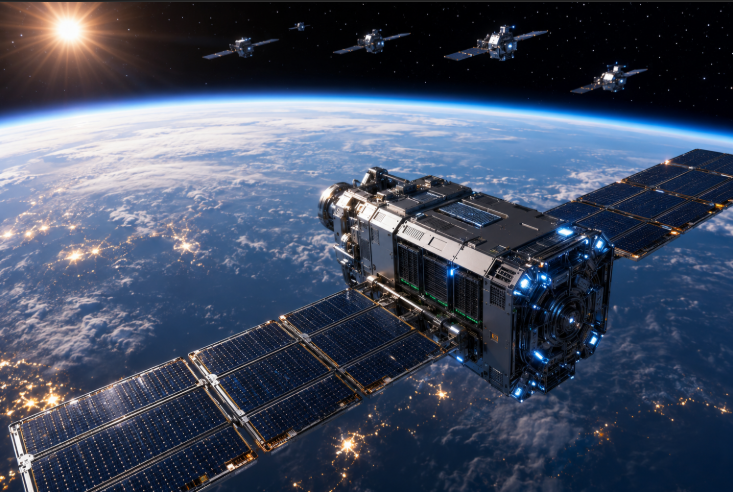
Orbital Data Centers: Startup Raises $5M for AI in Space

The race to support artificial intelligence is driving innovation in unexpected places. Orbital Data Centers are now emerging as a bold solution to growing computing demands. Euwyn Poon, the entrepreneur who co-founded the e-scooter company Spin, has secured $5 million in seed funding for his new startup, Orbital, which aims to bring AI computing infrastructure into orbit.
As AI applications continue to expand, technology companies are searching for new ways to access more computing power. Traditional data centers face increasing challenges, including power shortages, land constraints, cooling costs, and regulatory hurdles. Orbital believes the answer may be found beyond Earth’s atmosphere.
In this article, we explore Poon’s journey from urban mobility to space technology, how Orbital plans to operate in space, the opportunities and risks involved, and what this development could mean for the future of AI infrastructure.
Why Orbital Data Centers Are Capturing Investor Attention
Euwyn Poon is no stranger to building ambitious businesses. In 2017, he co-founded Spin, an electric scooter-sharing company that quickly expanded across major cities in the United States and Europe. The company’s rapid growth attracted the attention of Ford Motor Company, which acquired Spin just one year later.
Following his departure from Ford, Poon became increasingly interested in artificial intelligence and computing infrastructure. His hands-on experience running AI workloads on Nvidia hardware revealed a growing problem facing the industry: demand for computing resources is rising much faster than available capacity.
This realization eventually led him to Andreessen Horowitz’s Speedrun accelerator, where he explored multiple startup ideas before focusing on Orbital Data Centers. The concept gained enough momentum to secure a $5 million seed round backed by investors including Basis Set, Human Element, Wayfinder, and other technology-focused firms.
Orbital’s team combines expertise from organizations such as SpaceX, Amazon, and Northrop Grumman, bringing together experience in aerospace, satellite systems, and large-scale infrastructure.
How Orbital Data Centers Could Transform AI Infrastructure
Artificial intelligence requires massive amounts of computing power. Training large language models and running AI inference workloads consume significant energy and generate substantial heat.
Traditional data centers often struggle with three major issues:
- Limited power availability
- Rising cooling expenses
- Growing land requirements
Orbital Data Centers propose an alternative approach by placing computing hardware in orbit around Earth.
In space, satellites can access near-continuous solar energy when operating in favorable orbital paths. Unlike ground-based facilities, they are not affected by weather patterns, local power grid limitations, or expensive real estate markets.
This creates an opportunity to generate electricity directly from sunlight and use it to power AI workloads.
Another advantage involves thermal management. While cooling systems on Earth rely heavily on air conditioning, fans, and water systems, spacecraft can dissipate heat through radiative cooling technologies designed specifically for the vacuum of space.
If these systems perform as expected, orbital computing could eventually reduce some of the operational constraints faced by terrestrial facilities.
Orbital Data Centers and the AI Inference Opportunity
Orbital is not initially targeting the most demanding AI training workloads. Instead, the company plans to focus on AI inference, which involves running trained models to process data and generate outputs.
This strategy allows the company to enter the market sooner while proving the viability of its technology.
For example, satellites equipped with AI processors could analyze Earth observation imagery directly in orbit. Instead of transmitting massive datasets back to Earth, systems could process information onboard and send only the most valuable results.
This approach could improve efficiency for industries such as:
- Agriculture
- Climate monitoring
- Defense
- Disaster response
- Environmental research
By focusing on practical applications first, Orbital hopes to establish a sustainable business model before scaling to larger deployments.
The Orbital Data Centers Roadmap
Orbital’s development plan follows a step-by-step approach rather than attempting a massive deployment immediately.
The company plans to begin with demonstration missions that test critical technologies, including radiation protection and thermal management systems. One of the early goals is to place Nvidia Blackwell-based hardware aboard a partner spacecraft to evaluate performance in the harsh conditions of space. Energy Efficiency and Performance of Data Centers
If these tests prove successful, Orbital aims to launch dedicated processing satellites around 2028.
The long-term vision includes:
- Small-scale AI inference satellites
- Incremental deployment of processing nodes
- Expansion toward thousands of satellites
- Distributed gigawatt-scale computing capacity
Each satellite could potentially generate around 100 kilowatts of computing power, contributing to a larger network of space-based processors.
The roadmap remains ambitious, but it reflects the growing confidence investors have in the future of orbital computing.
Challenges Facing Orbital Data Centers
Despite the excitement surrounding the concept, major technical and financial obstacles remain.
Radiation exposure presents one of the biggest concerns. Spacecraft electronics are constantly exposed to radiation that can damage processors and memory systems. Effective shielding is essential but adds both weight and cost.
Launch expenses also remain significant. While launch costs have fallen dramatically over the past decade, deploying thousands of satellites still requires substantial investment.
Orbital’s business model partly depends on future launch vehicles such as the SpaceX Starship reducing transportation costs even further.
Additional challenges include:
- Maintaining hardware in orbit
- Managing communication latency
- Handling temperature fluctuations
- Replacing failed equipment
- Preventing space debris risks
These issues explain why Orbital is pursuing a cautious testing strategy before scaling operations. Key Features and Timelines for 6G Infrastructure Explained.
Competition in the Orbital Data Centers Market
Orbital is not alone in pursuing this vision.
Several startups and established aerospace companies are exploring similar concepts. Organizations such as Starcloud and Lumen Orbit are investigating orbital computing platforms, while major space companies continue to examine AI-enabled satellite systems.
Competition is expected to intensify as AI demand continues to accelerate.
However, industry observers believe there is room for multiple approaches. Different companies may specialize in various workloads, orbital configurations, and customer segments.
Just as cloud computing evolved into a diverse ecosystem of providers, orbital computing could follow a similar path over the coming decade.
What Orbital Data Centers Mean for the Future
The emergence of Orbital Data Centers highlights how rapidly AI infrastructure needs are evolving. As demand for computing power increases, businesses are being forced to think beyond traditional solutions.
If Orbital succeeds, space-based computing could offer:
- Access to abundant solar energy
- Reduced pressure on terrestrial power grids
- New processing capabilities near data sources
- Expanded infrastructure capacity for AI applications
However, success depends on several factors aligning simultaneously, including lower launch costs, reliable satellite technology, and continued growth in AI adoption.
For now, Orbital’s $5 million funding round represents an early but important step toward testing whether orbit can become the next frontier for computing infrastructure.
Conclusion
The story of Euwyn Poon demonstrates how innovation often comes from unexpected places. After building a successful e-scooter company, he is now pursuing one of the most ambitious infrastructure ideas in modern technology.
Orbital Data Centers may still be in their infancy, but the concept reflects a broader shift in how the industry approaches AI scalability. With increasing pressure on traditional facilities, companies are exploring new frontiers to meet future demand.
Whether orbital computing becomes mainstream remains uncertain. Yet one thing is clear: investors, engineers, and entrepreneurs increasingly believe that the future of AI may extend far beyond Earth.
Frequently Asked Questions
What are Orbital Data Centers?
They are satellite-based computing systems designed to perform AI and data processing tasks in space using solar-powered infrastructure.
Who founded Orbital?
Orbital was founded by Euwyn Poon, the co-founder of Spin, the e-scooter company acquired by Ford.
How much funding has Orbital raised?
The startup has secured $5 million in seed funding from several technology-focused investors.
Why put data centers in space?
Space offers access to continuous solar energy, fewer land constraints, and potential advantages for certain computing workloads.
What are the biggest challenges?
Key challenges include radiation exposure, launch costs, maintenance, thermal management, and communication infrastructure.
Author Profile

- Online Media & PR Strategist
- Hello there! I'm Online Media & PR Strategist at NeticSpace | Passionate Journalist, Blogger, and SEO Specialist
Latest entries
 AI WorkflowsJune 30, 2026X MCP Server Helps AI Tools Connect Faster and Smarter
 AI PlatformJune 19, 2026Microsoft AI Strategy Shapes China’s Enterprise AI Future
 AI WorkflowsJune 16, 2026Reliable AI Systems: Why Probably’s $9M Funding Matters
 AI WorkflowsJune 15, 2026AI Shopping Agents: Why Consumers Trust Them More