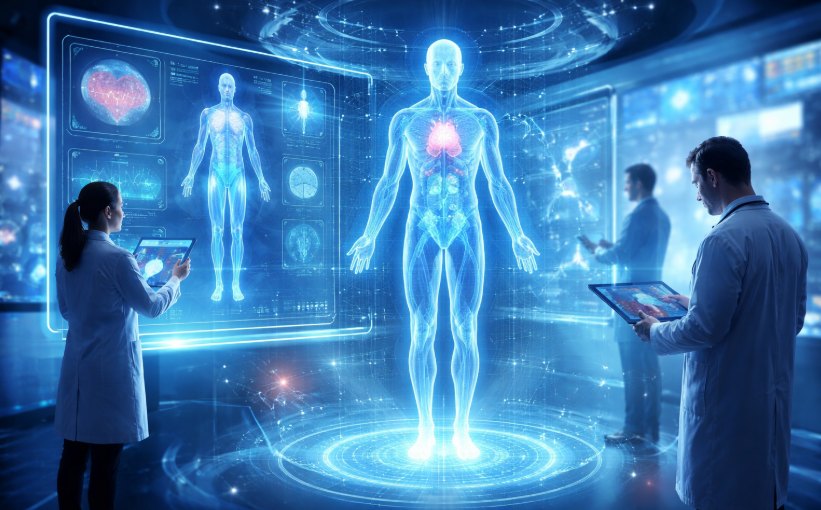
Digital Twin Technology Transforms Modern Healthcare Data

Digital Twin Technology is changing how modern medicine solves one of its biggest challenges—limited access to reliable patient data. What if doctors could safely test treatments on a virtual copy of your body? No risks. No privacy concerns. Just accurate predictions.
That future is already taking shape thanks to Mantis Biotech, a New York–based startup pioneering advanced virtual human models. By using Digital Twin Technology, the company is building realistic simulations that help researchers, doctors, and healthcare systems overcome data shortages.
Medical AI systems require massive datasets to function effectively. However, strict privacy laws and ethical concerns limit access to real patient data especially for rare diseases. This is where Digital Twin Technology becomes a breakthrough solution.
How Digital Twin Technology Works in Healthcare
Digital Twin Technology combines multiple data sources to create highly accurate virtual humans. These sources include medical imaging, biomechanics, wearable sensor data, and clinical research.
The process begins with collecting diverse datasets. Then, advanced AI systems analyze and validate this information. Missing data points are intelligently filled using synthetic generation techniques.
Finally, a physics-based engine creates realistic human simulations. These virtual models behave like real bodies—responding to movement, stress, and treatment scenarios.
One of the most powerful aspects of Digital Twin Technology is its ability to simulate rare or complex medical conditions. For example, if a dataset lacks images of a specific physical condition, the system can generate accurate representations without using real patient data.
This ensures both scientific reliability and privacy protection two critical factors in modern healthcare innovation.
Why Digital Twin Technology Solves Data Shortages
Healthcare has long struggled with data limitations. Rare diseases, unusual injuries, and unique biological variations are often underrepresented in datasets.
Digital Twin Technology addresses this gap by creating synthetic yet realistic data. Instead of relying solely on real-world records, researchers can now simulate thousands of scenarios.
This approach offers several advantages:
- Eliminates dependency on limited patient data
- Protects patient privacy and confidentiality
- Enables faster AI training and development
- Supports research on rare and complex conditions
According to insights from Y Combinator, startups leveraging synthetic data are accelerating innovation across industries, especially in healthcare.
By using Digital Twin Technology, researchers can explore possibilities that were previously impossible due to data scarcity.
Real-World Applications of Digital Twin Technology
The impact of Digital Twin Technology is already visible across multiple sectors, starting with professional sports.
An NBA team, for example, uses this technology to monitor athlete performance. Virtual models track movement patterns, sleep cycles, and training intensity. Coaches can identify injury risks before they occur.
In another scenario, Digital Twin Technology can simulate injury likelihood—such as predicting an Achilles tendon tear based on workload and recovery patterns.
Beyond sports, the applications expand significantly:
Healthcare and Hospitals
Doctors can test treatments on virtual patients before applying them in real life. This reduces risk and improves outcomes.
Pharmaceutical Research
Drug trials can be simulated using digital twins, speeding up development while reducing reliance on human testing.
Surgical Training
Robotic systems and surgeons can practice on realistic virtual bodies, improving precision and safety.
Preventative Healthcare
Individuals may soon monitor their health using personal digital twins, allowing early detection of potential issues.
For broader context on digital health advancements, resources like World Health Organization highlight the growing role of AI driven innovation in healthcare systems worldwide.
Funding Accelerates Digital Twin Technology Growth
The rise of Digital Twin Technology is backed by strong investor confidence. Mantis Biotech recently secured $7.4 million in seed funding.
The round was led by Decibel Partners, with participation from Y Combinator and other investors.
This funding will support:
- Expansion of engineering and research teams
- Scaling of the digital twin platform
- Increased adoption across healthcare and sports sectors
Currently, professional sports organizations are early adopters. However, the company plans to expand into hospitals, research labs, and eventually consumer healthcare.
You can explore more about their innovations on Mantis official site.
Future of Digital Twin Technology in Medicine
The future of Digital Twin Technology points toward a more personalized and predictive healthcare system.
Imagine visiting a doctor who can run multiple “what-if” scenarios on your digital twin before recommending treatment. This would allow:
- More accurate diagnoses
- Personalized treatment plans
- Reduced trial-and-error in medicine
- Faster recovery outcomes
As healthcare shifts toward precision medicine, Digital Twin Technology will play a central role. It bridges the gap between data limitations and real-world medical needs.
Internal innovations in AI and simulation are also expanding rapidly. Learn more about related advancements in AI-driven healthcare systems in our guide:
Digital Twin Body in Personalized Healthcare Future
Why Digital Twin Technology Matters Today
Healthcare innovation has often been slowed by data restrictions. Digital Twin Technology removes this barrier while maintaining ethical standards.
It enables:
- Faster research and development
- Safer clinical testing environments
- Broader access to medical insights
- Improved patient outcomes
Most importantly, it ensures that sensitive patient data remains protected while still contributing to scientific progress.
The success of companies like Mantis Biotech shows that synthetic data and virtual modeling are not just experimental they are becoming essential tools in modern medicine.
Digital Twin Technology Is the Next Medical Revolution
Digital Twin Technology is redefining how healthcare approaches data, research, and patient care. By creating realistic virtual humans, it unlocks new possibilities without compromising safety or privacy.
From sports performance tracking to advanced drug testing, its applications are vast and growing rapidly.
As adoption expands, this technology will likely become a standard part of medical practice—helping doctors make smarter decisions and improving lives worldwide.
The era of data limitations in healthcare is coming to an end—and Digital Twin Technology is leading the way.
Author Profile

- Online Media & PR Strategist
- Hello there! I'm Online Media & PR Strategist at NeticSpace | Passionate Journalist, Blogger, and SEO Specialist
Latest entries
 AI WorkflowsJune 30, 2026X MCP Server Helps AI Tools Connect Faster and Smarter
 AI PlatformJune 19, 2026Microsoft AI Strategy Shapes China’s Enterprise AI Future
 AI WorkflowsJune 16, 2026Reliable AI Systems: Why Probably’s $9M Funding Matters
 AI WorkflowsJune 15, 2026AI Shopping Agents: Why Consumers Trust Them More