
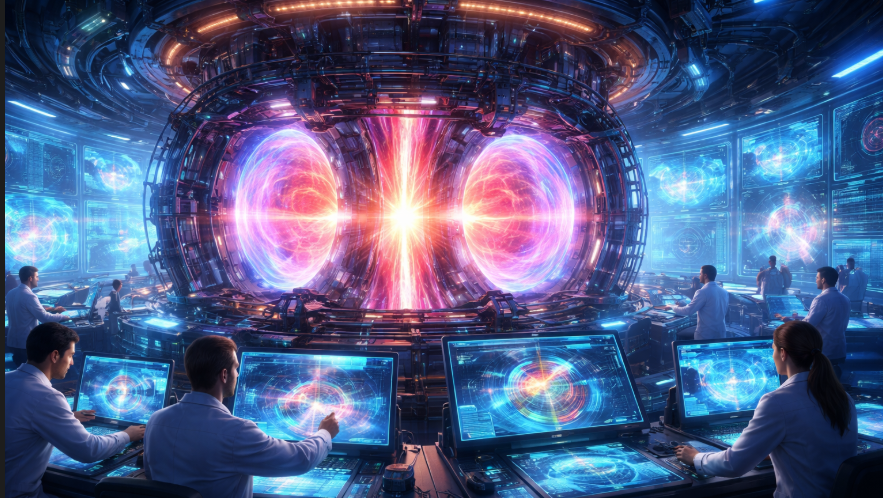
Digital Twins in Fusion Energy Research: Plasma Breakthroughs

Digital twins fusion energy research is transforming how scientists tackle one of the hardest problems in physics—creating clean, limitless energy. At its core, the idea is simple: build a virtual replica of a real system and test it safely in a digital world. In fusion research, this means simulating plasmas the extremely hot, unstable matter inside reactors—without risking billions in hardware.
Honestly, this approach is becoming essential. With projects like ITER pushing the boundaries of science, researchers need smarter, faster ways to predict outcomes. That’s where digital twins step in, helping scientists model, test, and refine fusion experiments before they happen in reality.
What Is Digital Twins Fusion Energy Research?
Fusing digital twins refers to creating highly detailed virtual models of fusion reactors and plasma behaviour. These models are constantly updated using real-world data, making them more accurate over time.
Think of it like a flight simulator but for nuclear fusion. Scientists can run thousands of scenarios, adjust parameters, and observe outcomes instantly.
How It Works
-
Real-time data feeds from experiments
-
Advanced physics-based simulations
-
AI and machine learning integration
-
Continuous model updates
This combination allows digital twins to mirror real fusion environments with impressive precision.
The Challenge of Plasmas in Digital Twins Fusion Energy Research
Plasmas are incredibly complex. They behave unpredictably, with turbulence, instabilities, and extreme temperatures reaching millions of degrees.
In Fusing digital twins research, simulating plasmas involves solving multiple physics equations at once. These include:
-
Magnetohydrodynamics (MHD)
-
Particle interactions
-
Heat and energy transport
Even with modern supercomputers, this is not easy. That’s why digital twins are so valuable they allow iterative testing and learning without physical risks.
How ITER Uses Digital Twins Fusion Energy Research
The ITER project is one of the most ambitious energy experiments ever built. Its goal is to demonstrate that fusion can produce more energy than it consumes.
Simulation Before Reality
In digital twins fusion energy research, ITER uses advanced computational models to simulate plasma scenarios before running real experiments. This helps:
-
Predict plasma instabilities
-
Optimise reactor conditions
-
Reduce operational risks
Integration with AI
AI enhances these models by learning from past simulations. Over time, the digital twins become smarter, enabling faster and more accurate predictions.
For more on fusion basics, you can explore resources like UK Atomic Energy Authority.
Benefits of Fusing digital twinsResearch
Using digital twins fusion energy research offers several clear advantages.
Faster Innovation
Scientists can test thousands of scenarios quickly. This speeds up discoveries without waiting for physical experiments.
Reduced Costs
Fusion experiments are extremely expensive. With digital twins, many tests happen virtually, saving money.
Improved Safety
Testing risky conditions digitally avoids damage to real reactors.
Better Decision-Making
Real-time insights help researchers make smarter choices during experiments.
Real-World Projects Advancing Digital Twins Fusion Energy Research
Several global initiatives are pushing this field forward.
EUROfusion and Virtual Plasma Models
The EUROfusion programme is developing advanced plasma simulations that act like digital twins. These models help researchers understand plasma behaviour in detail.
DIII-D and Interactive Twins
The DIII-D National Fusion Facility has explored interactive digital environments where scientists can visualise and control plasma simulations in real time.
Japan’s LHD Reactor
The Large Helical Device uses predictive modelling similar to digital twins fusion energy research to optimise plasma confinement.
For deeper insights into computational modelling, check our Build Smarter Digital Twins with What-If Tools.
Future of Digital Twins Fusion Energy Research
The future looks promising. As computing power grows and AI improves, digital twins fusion energy research will become even more accurate and accessible.
What to Expect
-
Real-time plasma control using digital twins
-
Fully integrated reactor simulations
-
Faster path to commercial fusion energy
Eventually, these systems could enable reactors to self-adjust, maintaining stable plasma automatically.
Conclusion: Why Digital Twins Fusion Energy Research Matters
In simple terms, digital twins fusion energy research is helping scientists move faster, safer, and smarter toward fusion power. By simulating plasmas in detail, researchers can avoid costly mistakes and focus on solutions that work.
Projects like ITER depend on this technology to succeed. And if they do, we could be looking at a future powered by clean, virtually limitless energy.
FAQs
What are digital twins in fusion energy?
They are virtual models of fusion reactors and plasmas that replicate real-world behaviour for testing and analysis.
Why are digital twins important for ITER?
They help predict outcomes, reduce risks, and optimise reactor performance before real experiments.
Can digital twins replace physical experiments?
No, but they significantly reduce the need for trial-and-error in real systems.
How accurate are digital twins?
Their accuracy improves over time as they learn from real data and simulations.
Will digital twins speed up fusion energy development?
Yes, they are expected to accelerate breakthroughs and reduce costs.
Author Profile

- Hey there! I am a Media and Public Relations Strategist at NeticSpace | passionate journalist, blogger, and SEO expert.
Latest entries
 AI WorkflowsJune 6, 2026Microsoft Scout Agent Transforms Productivity Across M365
 Design and SimulationApril 30, 2026Instagram Content Aggregators Rules for Reach 2026
 AI WorkflowsApril 29, 2026Agentic AI Model: GPT-5.5’s Biggest Leap Yet Explained
 Robotics SimulationApril 17, 2026Robot Brain Technology Transforms Modern Robotics Systems
