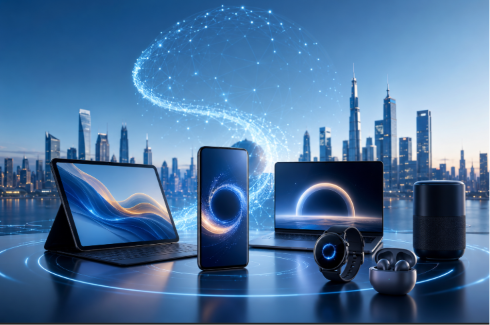
HarmonyOS AI Ecosystem Powers China’s Next AI Wave

Introduction
HarmonyOS AI Ecosystem is becoming one of the most important technology stories in China. As Apple continues to face challenges bringing advanced AI features to mainland China, Huawei is moving quickly to fill that space. This article explains what HarmonyOS 7 brings to the market, why it matters, and how it could reshape the future of mobile AI.
First, Huawei has introduced HarmonyOS 7 with a strong focus on AI agents and intelligent automation. Next, the company is expanding its software ecosystem across phones, tablets, PCs, wearables, and smart devices. Finally, these moves could give Chinese consumers an AI experience that Apple currently cannot fully provide in the region. Huawei HarmonyOS Platform
Why the HarmonyOS AI Ecosystem Matters in China
China has become one of the world’s most competitive AI markets. Consumers increasingly expect their devices to understand context, automate tasks, and work across multiple screens.
However, Apple’s newest AI features remain unavailable in mainland China because of regulatory and operational hurdles. This situation has created an opportunity for local companies. Huawei appears ready to seize that opportunity with HarmonyOS 7 and its growing AI platform.
For Huawei, the timing is important. HarmonyOS already holds a significant share of China’s mobile operating system market, giving the company a strong foundation for AI expansion.
How the HarmonyOS AI Ecosystem Addresses the AI Gap
Huawei’s approach goes beyond adding a chatbot to a smartphone.
Instead, HarmonyOS 7 introduces what Huawei calls an agent-friendly architecture. The system allows intelligent agents to perform tasks, understand context, remember previous interactions, and coordinate actions across devices.
For example, users can request personalized schedules, locate files on connected devices, generate content, or complete multi-step workflows through a single assistant. This creates a more connected experience than traditional voice assistants.
The Evolution of the HarmonyOS AI Ecosystem
Huawei has spent years building HarmonyOS into a complete technology platform.
Initially, HarmonyOS focused on connecting devices. Today, the platform supports smartphones, tablets, laptops, wearables, smart home products, and even automotive systems. Huawei reports that HarmonyOS now operates across a massive device ecosystem, helping create a unified user experience. AI Data Foundation: Why AI Agents Fail Without It
The latest release pushes that vision further.
Agent Technology Inside the HarmonyOS AI Ecosystem
One of the biggest upgrades in HarmonyOS 7 is the Intelligent Agent Framework 2.0.
According to Huawei, the framework improves complex task completion rates to above 90 percent. The company also says developers can create AI-powered services more efficiently using the updated framework.
Key capabilities include:
- Context-aware conversations
- Cross-device task execution
- Intelligent recommendations
- AI-assisted content creation
- Advanced automation workflows
- Personalized user assistance
These features move AI from a simple assistant role toward a more active digital helper.
How the HarmonyOS AI Ecosystem Competes With Apple
Apple remains one of the world’s strongest consumer technology brands. Yet software availability and regulatory realities vary from market to market.
In China, Huawei benefits from deep local integration. The company can partner with domestic developers, services, and AI providers more directly than many international competitors.
As a result, HarmonyOS can offer AI features tailored specifically for Chinese users.
Developer Opportunities in the HarmonyOS AI Ecosystem
Developers often determine whether an operating system succeeds.
Huawei is actively encouraging software creators to build for HarmonyOS 7. The developer beta includes AI coding agents, improved development tools, and expanded frameworks for intelligent applications.
Recent announcements also suggest stronger software support for HarmonyOS PCs, including developer-focused tools and IDE integration.
This matters because developers want:
- Large user bases
- Modern AI frameworks
- Strong monetization opportunities
- Reliable platform support
Huawei appears focused on all four areas.
Security and Performance Across the HarmonyOS AI Ecosystem
AI features are only useful if users trust them.
Huawei has added several security-focused capabilities to HarmonyOS 7. These include fraud detection, suspicious QR code identification, scam call detection, and protection against app impersonation.
At the same time, Huawei claims performance improvements compared with previous versions.
Reported enhancements include:
- Faster application launches
- Improved memory efficiency
- Better long-term performance stability
- Enhanced multitasking
- More responsive system interactions
These upgrades help support increasingly demanding AI workloads.
Future Growth of the HarmonyOS AI Ecosystem
The next phase of mobile computing may not revolve around apps alone.
Instead, intelligent agents could become the primary interface between users and technology. HarmonyOS 7 positions Huawei for that future by making AI a core operating system function rather than a separate feature.
If Huawei successfully expands developer participation and consumer adoption, HarmonyOS could strengthen its position not only in China but also across other markets where Huawei products remain popular.
Business Impact of the HarmonyOS AI Ecosystem
The broader technology industry is watching closely.
A successful HarmonyOS AI strategy could influence:
- Mobile operating systems
- Enterprise software
- Smart home ecosystems
- Automotive technology
- AI assistant development
- Cross-device computing
The result could be increased competition for both Apple and Google in AI-powered user experiences.
Conclusion
Huawei’s latest operating system represents more than a software update. HarmonyOS 7 shows how local technology companies can build AI experiences tailored to their own markets while creating alternatives to global platforms. As Apple continues navigating AI deployment challenges in China, the HarmonyOS AI Ecosystem is emerging as a serious contender for the next generation of intelligent computing.
The real question is no longer whether AI belongs inside operating systems. Instead, it is which ecosystem will deliver the most useful and trusted experience for users.
Frequently Asked Questions
What is HarmonyOS 7?
HarmonyOS 7 is Huawei’s latest operating system featuring AI agents, intelligent automation, and cross-device integration.
Why is HarmonyOS important in China?
HarmonyOS offers locally developed AI capabilities that can operate within China’s regulatory environment, helping fill gaps left by unavailable foreign AI services.
What makes the HarmonyOS AI Ecosystem different?
It combines AI agents, smart assistants, device connectivity, and application integration into a single platform.
Can HarmonyOS AI work across multiple devices?
Yes. HarmonyOS is designed to connect smartphones, tablets, PCs, wearables, and other devices into one coordinated ecosystem.
Is HarmonyOS competing with Apple?
Yes. Huawei is positioning HarmonyOS as a strong alternative to Apple’s ecosystem, especially in China where AI availability differs between platforms.
Author Profile

- Online Media & PR Strategist
- Hello there! I'm Online Media & PR Strategist at NeticSpace | Passionate Journalist, Blogger, and SEO Specialist
Latest entries
 AI WorkflowsJune 30, 2026X MCP Server Helps AI Tools Connect Faster and Smarter
 AI PlatformJune 19, 2026Microsoft AI Strategy Shapes China’s Enterprise AI Future
 AI WorkflowsJune 16, 2026Reliable AI Systems: Why Probably’s $9M Funding Matters
 AI WorkflowsJune 15, 2026AI Shopping Agents: Why Consumers Trust Them More