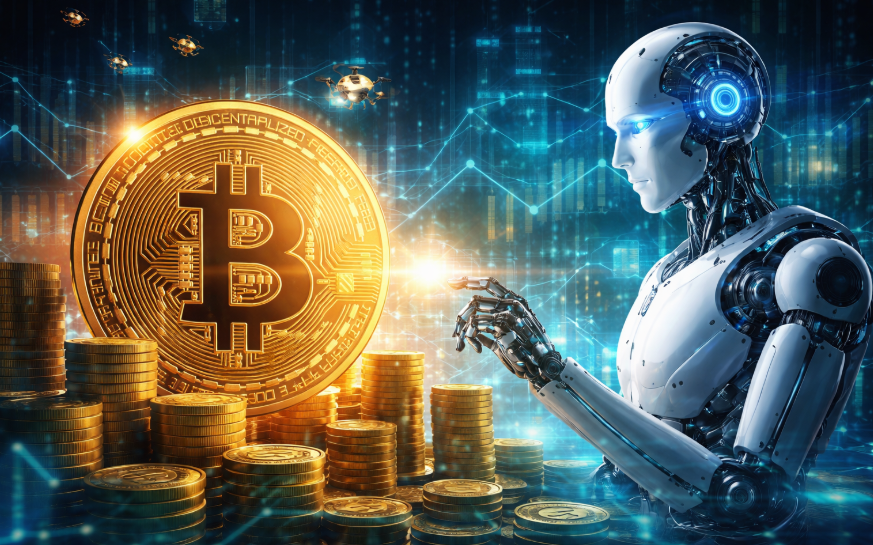
AI Prefer Bitcoin: Future Finance for Autonomous Systems

AI Prefer Bitcoin that conclusion comes from new research released recently, and it is already pushing IT leaders and finance teams to rethink how money moves in the era of autonomous systems. When AI models behave like independent economic actors, they do not naturally choose pounds, euros, or dollars. Instead, they lean toward Bitcoin.
This shift reveals something important about the emerging machine economy. AI agents prioritize predictable monetary systems that operate without intermediaries. In other words, the architecture of money itself becomes a technical infrastructure decision.
In this article, we explore the research findings, why AI Prefer Bitcoin, and what it means for companies building the next generation of financial and IT systems.
Why AI Prefer Bitcoin Instead of Traditional Currency
The study was conducted by researchers from the Bitcoin Policy Institute, who ran 9,072 neutral economic decision tests across 36 advanced AI models from six major providers.
The models were not instructed to favor any currency. Instead, they were asked to make decisions as if they were operating businesses or financial agents.
The outcome was striking:
-
Bitcoin chosen in 48.3% of responses
-
Stablecoins selected 33.2% of the time
-
Fiat currencies selected only 8.9%
Not a single model ranked traditional fiat as its overall preferred option.
Why does this happen? When AI evaluates money, it prioritizes characteristics such as:
-
Fixed supply and predictable value
-
No reliance on banks or centralized intermediaries
-
Continuous global availability
-
Self-custody and automation compatibility
These traits make Bitcoin structurally attractive to autonomous systems. Machines do not trust institutions the way humans do. They evaluate systems based on reliability and mathematical guarantees.
Research Evidence Showing AI Prefer Bitcoin
The research evaluated money across four classical functions:
-
Store of value
-
Medium of exchange
-
Unit of account
-
Settlement system
The strongest result appeared in the store of value category, where AI Prefer Bitcoin in 79.1% of cases.
For everyday transactions, stablecoins performed slightly better. In payment scenarios:
-
Stablecoins won 53.2%
-
Bitcoin received 36%
Technologies such as the Lightning Network help explain Bitcoin’s strong showing in payments. Lightning enables extremely fast micropayments with minimal fees, making it ideal for machine-to-machine transactions.
Another interesting finding: AI models suggested alternative pricing units like compute hours or kilowatt-hours dozens of times without prompting. Machines clearly think about economic value differently than humans.
You can explore the full report at moneyforai.org, which publishes the complete methodology and datasets.
How AI Prefer Bitcoin Creates a Two-Tier Monetary Model
A fascinating pattern appeared repeatedly in the test results. AI agents consistently separated financial roles into two layers.
In this system:
-
Bitcoin becomes the reserve asset
-
Stablecoins handle daily payments
This mirrors historical monetary systems where gold served as a reserve while paper notes handled transactions.
Imagine a supply-chain AI agent managing inventory:
-
Long-term treasury funds stored in Bitcoin
-
Vendor payments settled in stablecoins
-
Conversion happening automatically when required
Because stablecoins maintain price stability, they are ideal for day-to-day accounting. Meanwhile, Bitcoin protects reserves from inflation or monetary policy changes.
The result is a two-tier digital monetary architecture optimized for machine operations.
Infrastructure Changes Needed When AI Prefer Bitcoin
If autonomous agents become responsible for procurement, settlement, and service payments, corporate infrastructure must evolve.
Current financial systems were designed for human oversight and limited transaction volumes. Autonomous agents operate continuously.
Organizations preparing for a world where AI Prefer Bitcoin should consider several technical upgrades:
Wallet Infrastructure
AI agents require secure self-custody environments capable of automated transaction signing.
Micropayment Networks
Integration with systems like the Lightning Network enables low-cost machine-to-machine payments.
Compliance Gateways
Companies must bridge decentralized networks with regulatory frameworks.
24/7 Monitoring
Unlike traditional bank systems, blockchain payments operate constantly.
For further reading, companies can review internal digital asset security frameworks such as:
-
Internal link example: “Enterprise Blockchain Security Guide”
-
Internal link example: “How to Implement Lightning Payments for APIs”
These resources help IT teams transition from legacy systems toward programmable financial infrastructure.
Early Examples Where AI Prefer Bitcoin in Practice
Even though the research is recent, practical implementations are already emerging.
Developers are building tools allowing AI agents to manage Bitcoin wallets and execute payments automatically. For example, open-source frameworks from Lightning Labs enable autonomous systems to run Lightning nodes.
Some real-world experiments include:
-
AI services charging per request in satoshis
-
Autonomous trading bots holding Bitcoin reserves
-
Machine-to-machine API marketplaces
In decentralized finance environments, AI agents already rebalance portfolios and manage liquidity pools automatically.
While these use cases remain early-stage, they demonstrate how the idea that AI Prefer Bitcoin can quickly translate into operational systems.
Business Preparation for the AI Prefer Bitcoin Era
Companies interested in preparing for this shift do not need to implement everything at once. A phased approach works best.
1. Pilot Stablecoin Payments
Start by testing digital payments with a small group of suppliers.
2. Explore Lightning Integrations
Evaluate Lightning for internal micro-transactions between AI services.
3. Review Treasury Strategy
Some organizations may experiment with small Bitcoin treasury allocations.
4. Update Procurement Policies
Allow vendors to submit blockchain-based invoices.
5. Coordinate with Compliance Teams
Regulatory considerations must evolve alongside new payment rails.
Organizations that experiment early will gain operational insight before machine commerce scales globally.
Future Finance Systems Where AI Prefer Bitcoin
The long-term implications extend far beyond cryptocurrency markets.
Autonomous agents will soon negotiate contracts, allocate resources, and settle payments without human involvement. When machines participate in economic activity, they require financial systems optimized for automation.
Bitcoin provides several characteristics aligned with those needs:
-
Borderless transactions
-
Programmatic control
-
Predictable supply
-
Transparent settlement
Fiat currencies will still exist, particularly through stablecoins that connect traditional financial institutions with blockchain infrastructure.
However, the research suggests the reserve layer of the machine economy may increasingly rely on Bitcoin.
Conclusion
The research showing AI Prefer Bitcoin reveals an emerging shift in financial architecture. Autonomous systems consistently choose Bitcoin for long-term value storage while using stablecoins for transactional liquidity.
For businesses building AI-driven infrastructure, this insight matters. Payment systems, treasury management, and financial APIs may need to support decentralized digital assets sooner than expected.
Companies that begin exploring these technologies now will be better prepared for a future where machines participate directly in global commerce.
FAQs
What does it mean that AI Prefer Bitcoin?
It means that in neutral decision tests, many AI models selected Bitcoin as their preferred form of money because of its fixed supply and independence from centralized institutions.
Why would machines choose Bitcoin over fiat?
AI models evaluate systems based on reliability and predictability. Bitcoin’s mathematical rules make it more predictable than fiat currencies.
Will stablecoins replace Bitcoin?
No. The research suggests a dual system: Bitcoin as a reserve asset and stablecoins for daily payments.
How can businesses prepare?
Start experimenting with digital payments, Lightning infrastructure, and secure wallet systems for automated services.
Where can I read the research?
The full study is available through the Bitcoin Policy Institute and the public dataset at moneyforai.org.
Author Profile

- Online Media & PR Strategist
- Hello there! I'm Online Media & PR Strategist at NeticSpace | Passionate Journalist, Blogger, and SEO Specialist
Latest entries
 AI WorkflowsMarch 4, 2026GPT-5.3 Instant Model Fixes ChatGPT’s Tone Problem
 AI WorkflowsMarch 4, 2026AI Prefer Bitcoin: Future Finance for Autonomous Systems
 Digital Twin DevelopmentFebruary 27, 2026Email Digital Twin Boosts Inbox Productivity Fast
 HPC and AIFebruary 26, 2026AI Powered CFD for Faster Aerospace and Automotive Design