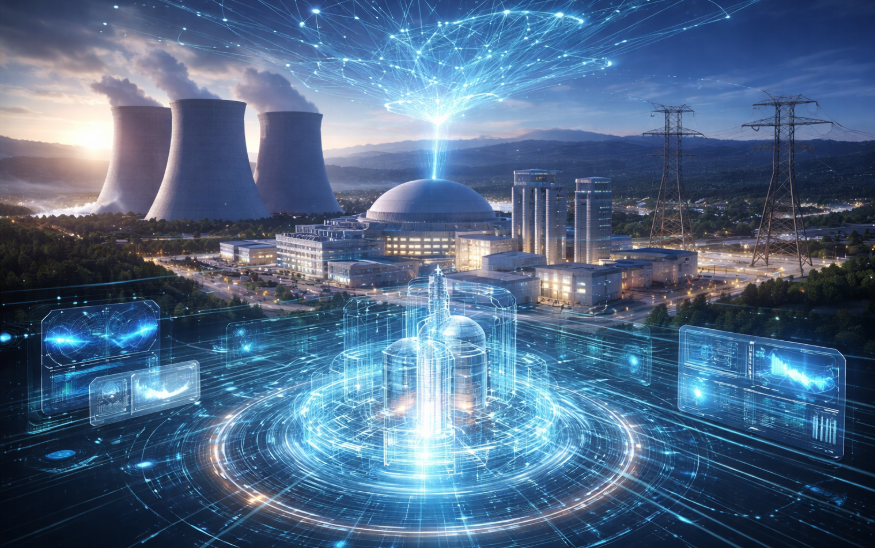
AI Nuclear Energy Future: Smarter, Safer Power Systems

AI nuclear energy is now at the centre of two major global shifts. On one side, artificial intelligence systems require massive, continuous electricity to power data centres. On the other, nuclear energy provides reliable, low-carbon power—but has long faced delays, complex regulations, and rising costs.
You know what? The same technology driving energy demand is now solving these challenges. This article explores how AI nuclear energy is reshaping design, permitting, safety, and operations—while supporting the growing needs of modern infrastructure.
Why AI Nuclear Energy Is Becoming Essential
Energy demand is rising faster than ever. Data centres alone are projected to consume electricity at levels comparable to entire nations. While renewable sources play a vital role, they are not always consistent. Nuclear energy, however, delivers stable, always-on power with minimal emissions.
Still, the industry faces long-standing issues. Permitting takes years, documentation is complex, and construction delays are common.
That’s where AI nuclear energy makes a difference. AI tools transform fragmented data into structured insights, automate repetitive processes, and simulate outcomes before construction begins. This shift makes nuclear energy more efficient, scalable, and responsive to modern needs.
How AI Nuclear Energy Improves Design and Permitting
Traditionally, nuclear plant design involved extensive manual work. Engineers created thousands of documents, cross-checked them, and navigated strict regulatory requirements.
With AI nuclear energy, this process becomes smarter. Generative AI tools draft documents, identify inconsistencies, and align designs with previous regulatory approvals. This reduces human error and speeds up reviews.
Digital twins play a key role here. These virtual models allow engineers to test plant designs under real-world conditions before construction begins. They can evaluate performance, cost, and safety impacts instantly.
In addition, advanced simulations such as 4D and 5D modeling add time and cost dimensions. This helps teams identify risks early and avoid delays. Some projects have already reduced permitting timelines dramatically using these tools.
Learn more about digital twin technology.
Real-World Applications of AI Nuclear Energy
Across the industry, organisations are already adopting AI nuclear energy solutions.
Large utilities use AI to consolidate engineering knowledge across multiple reactor sites. This improves decision-making and reduces repeated mistakes. National laboratories automate complex safety documentation, allowing experts to focus on critical analysis instead of formatting.
Meanwhile, advanced nuclear startups are applying AI directly to licensing processes. By automating documentation and validation, they significantly reduce approval timelines without compromising safety.
These real-world examples prove that AI nuclear energy is not theoretical it’s already delivering measurable results.
Enhancing Safety and Operations with AI Nuclear Energy
Once a nuclear plant is operational, maintaining safety and efficiency becomes the top priority. Thousands of sensors generate continuous data streams, far beyond what humans can monitor manually.
AI nuclear energy systems analyze this data in real time. Predictive models detect early signs of equipment wear, while digital twins compare actual performance against ideal conditions.
Operators receive clear alerts along with explanations, enabling faster and more informed decisions. Maintenance becomes proactive rather than reactive, reducing downtime and operational costs.
Additionally, AI helps balance electricity supply with demand. As AI-driven workloads increase, nuclear plants can adjust output smoothly while maintaining strict safety limits.
CAE Fusion Design in Nuclear Reactor Development
Building an Ecosystem Around AI Nuclear Energy
The growth of AI nuclear energy depends on collaboration across industries. Cloud providers offer secure infrastructure, startups deliver specialised AI tools, and hardware companies develop advanced simulation systems.
Together, they create scalable and regulated environments where data remains traceable and AI models remain explainable. This transparency is essential for regulatory approval and long-term adoption.
Modern platforms now offer ready to use solutions, including document automation, visual inspections, and performance forecasting. What once seemed futuristic is quickly becoming standard practice.
Challenges Facing AI Nuclear Energy Adoption
Despite its benefits, AI nuclear energy still faces challenges. Nuclear energy is one of the most regulated industries, and rightly so. Any AI system must prove it enhances safety without introducing risk.
Data quality is another issue. Many existing plants rely on decades-old records stored in different formats. Cleaning and standardising this data requires time and effort.
Cybersecurity is equally critical. As nuclear facilities adopt digital technologies, they must ensure strong protection against potential threats.
However, the industry is actively addressing these concerns through secure cloud systems, human-in-the-loop designs, and continuous model validation.
Why Professionals Should Care About AI Nuclear Energy
If you work in IT, cloud computing, or data engineering, AI nuclear energy directly impacts your field. Data centre operators are increasingly partnering with nuclear providers to secure stable energy supplies.
Understanding how AI accelerates nuclear deployment helps you plan infrastructure more effectively. It also opens new opportunities in areas like simulation, monitoring systems, and AI-driven analytics.
The skills required machine learning, data pipelines, and secure systems are already in demand across industries. This makes the transition into energy-focused roles more accessible than ever.
Explore AI applications in energy.
The Future of AI Nuclear Energy
Nuclear energy has always held the promise of reliable, low-carbon power. With AI nuclear energy, that promise becomes more achievable and scalable.
We are already seeing faster project timelines, improved safety insights, and more efficient operations. Technologies like digital twins and generative AI are no longer experimental—they are actively transforming the industry.
The future will depend on continued collaboration between technology providers, energy companies, and regulators. As these partnerships grow, the impact of AI on nuclear energy will only accelerate.
FAQs
What is AI nuclear energy?
It refers to using artificial intelligence to improve the design, construction, licensing, and operation of nuclear power plants.
Does AI replace human experts in nuclear systems?
No. AI supports decision-making, but human experts remain fully in control of safety-critical processes.
How does AI nuclear energy support data centres?
It speeds up reactor deployment and improves reliability, ensuring a steady power supply for AI workloads.
Is AI nuclear energy already in use?
Yes. It is being used for predictive maintenance, digital twins, permitting automation, and operational optimization.
What skills are needed in this field?
Skills in machine learning, data engineering, simulation, and cybersecurity are highly valuable.
Author Profile

- Online Media & PR Strategist
- Hello there! I'm Online Media & PR Strategist at NeticSpace | Passionate Journalist, Blogger, and SEO Specialist
Latest entries
 Computer Aided-EngineeringMarch 24, 2026AI Nuclear Energy Future: Smarter, Safer Power Systems
 AI WorkflowsMarch 24, 2026Apple WWDC 2026 AI Updates and Developer Insights
 Computer Aided-EngineeringMarch 18, 2026CAE in Sports Equipment Design: Performance & Safety Boost
 AI WorkflowsMarch 18, 2026Nvidia AI Graphics Backlash Explained for Gamers Today