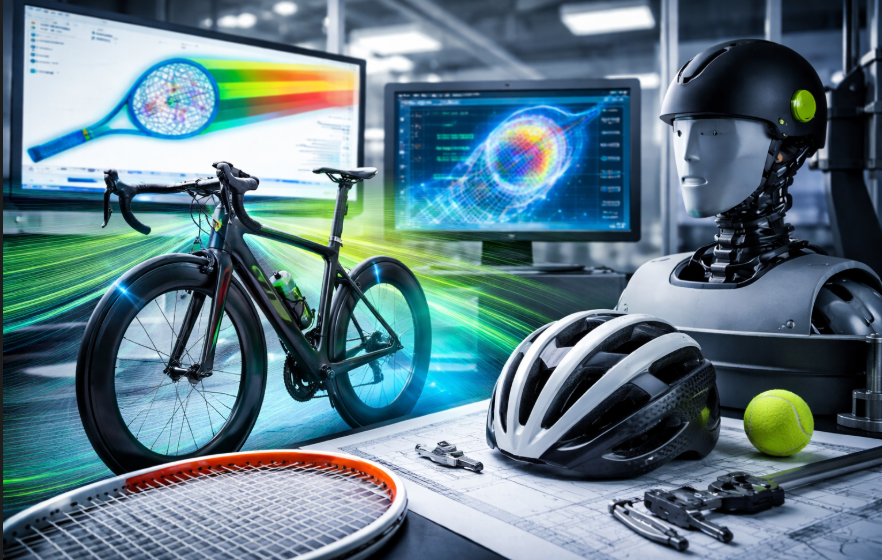
CAE in Sports Equipment Design: Performance & Safety Boost

Sports equipment design has evolved rapidly with the rise of computer-aided engineering (CAE). Today, engineers rely on simulations to test ideas before creating physical prototypes, making development faster and more efficient.
This shift allows designers to build gear that performs better, lasts longer, and protects athletes more effectively. From professional-level equipment to everyday fitness tools, CAE is reshaping how innovation happens in the industry.
Honestly, it’s fascinating how much virtual testing now replaces traditional trial-and-error.
What CAE Means in Sports Equipment Design
CAE, or computer-aided engineering, uses advanced software to simulate real-world conditions like stress, airflow, and impact. In equipment design, this eliminates much of the guesswork involved in traditional development.
The process is straightforward but powerful:
-
Engineers create a digital model
-
Apply forces like pressure or motion
-
Analyze how the product behaves
This approach helps identify weaknesses early, saving both time and money.
Learn more about CAE basics from ANSYS
Explore engineering tools at Siemens
Performance Optimization
Performance improvements are where CAE truly shines. In sports equipment design, even the smallest adjustments can make a huge difference.
Designers can:
-
Reduce drag in aerodynamic gear
-
Improve stiffness without adding weight
-
Optimize balance and control
For example, a slight reduction in air resistance can translate into faster race times. Similarly, tuning a tennis racket’s stiffness improves both power and precision.
These small gains often separate winners from the rest.
Aerodynamics and CFD in Sports Equipment Design
Computational Fluid Dynamics (CFD) plays a major role in sports equipment design. It simulates how air or water flows around an object, helping engineers refine shapes for maximum efficiency.
Applications include:
-
Golf balls with optimized dimple patterns
-
Bicycle frames designed for minimal drag
-
Swimwear engineered for reduced water resistance
By running hundreds of simulations, engineers can find the best design without building multiple prototypes.
For deeper reading, check out Will Quantum Computing CAE Revolutionize Engineering?
Structural Strength Using FEA in Sports Equipment Design
Finite Element Analysis (FEA) is another essential tool in sports equipment design. It breaks down objects into small elements to test stress, vibration, and deformation.
This helps engineers create equipment that is both:
-
Lightweight
-
Durable
Examples include:
-
Tennis rackets optimized for impact response
-
Skis engineered for flexibility and strength
-
Protective gear designed to withstand repeated use
FEA ensures products perform under pressure without unnecessary weight.
Safety Innovation in Sports Equipment Design
Safety is critical, and CAE plays a huge role in improving it. In sports equipment design, simulations allow engineers to model real-world accidents and impacts.
Helmet testing, for instance, uses digital crash simulations to predict how force travels through materials. This helps reduce injury risks by improving shock absorption.
Fields benefiting from this include:
-
Cycling helmets
-
Football protective gear
-
Combat sports head protection
Learn about safety standards from ISO
Real-World Applications of Sports Equipment Design
CAE is already widely used across the sports industry. In sports equipment design, real-world applications include:
-
Golf balls optimized for longer flight distances
-
Aerodynamic bicycles that reduce energy loss
-
Tennis rackets tuned for better control
-
Rowing boats designed for smoother water flow
-
High-performance swimwear reducing drag
These innovations help athletes perform at their best while pushing the limits of technology.
Key Benefits of Sports Equipment Design with CAE
The advantages of CAE in sports equipment design are clear and measurable:
Faster Development
Virtual testing reduces the need for physical prototypes.
Lower Costs
Less material waste and fewer failed designs.
Better Performance
Precision engineering leads to measurable improvements.
Enhanced Safety
Early detection of design flaws prevents injuries.
Greater Customization
Athlete-specific gear becomes easier to produce.
Many companies now rely heavily on simulation tools to stay competitive.
Future Trends
The future of equipment design is even more exciting. Emerging technologies are taking CAE to the next level:
-
Digital twins that track real-world performance
-
Generative design creating innovative shapes
-
AI integration speeding up design cycles
These advancements will continue to push boundaries, helping athletes achieve new levels of performance.
In short, CAE is not just improving equipment—it’s redefining what’s possible.
FAQ
What is sports equipment design in CAE?
It refers to using simulation tools to design and test sports gear virtually before manufacturing.
How does CAE improve sports equipment design?
It enhances performance, reduces costs, and improves safety through accurate simulations.
Is sports equipment design with CAE expensive?
Not necessarily. Cloud-based tools have made it accessible even for smaller brands.
Can beginners benefit from sports equipment design tools?
Yes, many platforms offer scalable solutions suitable for different skill levels.
How fast is development with sports equipment design using CAE?
Many teams reduce prototype cycles by over 50%, significantly speeding up production.
Author Profile

- Online Media & PR Strategist
- Hello there! I'm Online Media & PR Strategist at NeticSpace | Passionate Journalist, Blogger, and SEO Specialist
Latest entries
 AI WorkflowsJune 30, 2026X MCP Server Helps AI Tools Connect Faster and Smarter
 AI PlatformJune 19, 2026Microsoft AI Strategy Shapes China’s Enterprise AI Future
 AI WorkflowsJune 16, 2026Reliable AI Systems: Why Probably’s $9M Funding Matters
 AI WorkflowsJune 15, 2026AI Shopping Agents: Why Consumers Trust Them More