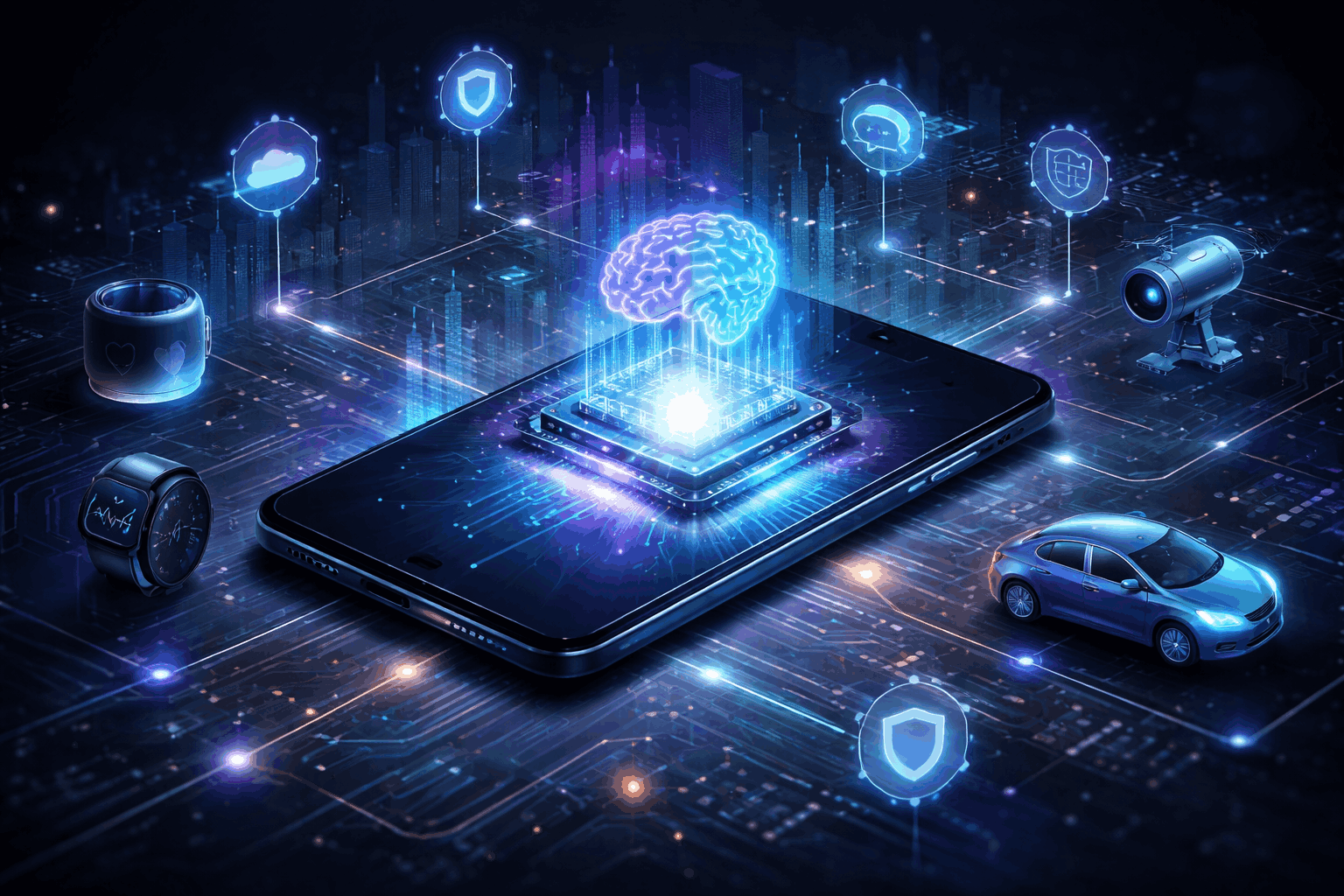
On Device AI Processing for Faster, Private Mobile Interfaces

On Device AI is transforming how modern mobile and edge devices deliver intelligent experiences without relying heavily on cloud servers. Instead of sending data back and forth over the internet, smart processing happens directly on the device, resulting in faster responses and stronger privacy. This shift is redefining user expectations around speed, security, and reliability in everyday technology. In this article, we’ll explore how this approach works, why it matters, and where it’s headed next.
What Is On Device AI Processing?
On Device AI refers to running artificial intelligence models locally on hardware such as smartphones, wearables, cameras, and other edge devices. Traditionally, AI workloads depended on remote cloud servers. While powerful, that setup introduced latency, connectivity issues, and privacy concerns.
Modern devices now include dedicated hardware like Neural Processing Units (NPUs), enabling efficient local computation. For example, Qualcomm’s Snapdragon platforms integrate AI engines designed specifically for real-time tasks such as image recognition and voice processing. By handling these operations locally, devices deliver instant feedback without waiting for network responses.
Edge devices benefit even more. Processing data at the source reduces delays in applications like industrial monitoring, smart surveillance, and real-time analytics.
Privacy Benefits of On Device AI
Privacy is one of the strongest advantages of On Device AI. Since sensitive data never leaves the device, the risk of interception, unauthorized access, or large-scale breaches is significantly reduced. This is especially important for biometric data such as facial scans, fingerprints, and voice profiles.
Companies like Samsung highlight this approach in their semiconductor designs, ensuring secure AI execution within trusted hardware environments. You can explore more about this strategy on Samsung’s official semiconductor blog.
Another benefit is offline functionality. AI-powered features continue to work even without internet access, giving users greater control and reliability wherever they are.
How On Device AI Improves Interface Speed
One major reason interfaces feel faster today is On Device AI eliminating network latency. Tasks like voice commands, predictive text, and image enhancements are processed instantly, making apps feel smooth and responsive.
To support this, developers rely on optimized small language models (SLMs) that are lightweight and power efficient. Google provides tools to deploy such models on Android and iOS platforms.
In augmented reality and gaming, this local processing enables real-time interactions without lag, dramatically improving user experience.
Mobile Applications Powered by On Device AI
Smartphones are the most visible example of On Device AI in action. Camera features like scene detection, portrait mode, and low-light enhancement all happen locally and almost instantly.
Wearable devices also rely heavily on this approach. Health data such as heart rate, sleep cycles, and activity patterns are analyzed on device, protecting personal information. The European Data Protection Supervisor has highlighted local processing as a privacy friendly model for consumer technology.
Common mobile use cases include:
-
Voice recognition in assistants
-
Real-time language translation
-
Predictive text and autocorrect
-
Gesture-based gaming controls
These applications make daily interactions faster and more intuitive.
On Device AI in Edge Devices
Beyond phones, On Device AI plays a critical role in edge computing. IoT sensors in factories analyze data locally to detect faults or anomalies without constant cloud communication.
Security cameras are another strong example. Instead of streaming all footage to remote servers, devices process video locally to identify threats in real time. IBM explains this edge AI model in detail.
In automotive systems, local AI enables driver assistance features such as lane detection and obstacle avoidance, where even milliseconds matter for safety.
Challenges of Implementing On Device AI
Despite its advantages, On Device AI comes with challenges. Devices have limited memory, processing power, and battery life. AI models must be carefully compressed and optimized to run efficiently.
Power consumption is another concern. Continuous AI processing can drain batteries quickly if not managed properly. Research published on arXiv discusses these trade offs and optimization techniques.
To address these issues, some applications use hybrid models that combine local processing with selective cloud support when needed.
Future Trends in On Device AI
The future of On Device AI looks promising. Faster networks like 5G enhance edge intelligence by supporting better coordination between devices, even while keeping most processing local.
Hardware innovation is accelerating as well. Specialized AI chips continue to evolve, enabling more complex tasks such as multimodal processing across text, images, and audio. Companies like Picovoice are already advancing on-device voice AI.
Stricter global privacy regulations are also encouraging developers to adopt local processing models to ensure compliance.
Security Considerations for On Device AI
From a security perspective, On Device AI reduces exposure to online attacks by minimizing data transmission. AI models run in isolated environments, lowering the risk of external exploitation.
That said, hardware-level attacks and firmware vulnerabilities remain possible. Regular software updates and secure boot mechanisms are essential safeguards.
Overall, this approach shifts security responsibility toward device-level protections rather than network defenses.
On Device AI vs Cloud-Based AI
Comparing On Device AI to cloud-based AI highlights clear trade-offs. Cloud AI offers scalability and raw computing power, but it depends heavily on connectivity and raises privacy concerns.
Coursera provides a clear breakdown of these differences.
Quick comparison:
-
Latency: Low vs High
-
Privacy: High vs Variable
-
Offline support: Yes vs No
-
Scalability: Limited vs Extensive
Choosing the right approach depends on application needs.
Integrating On Device AI into Custom Apps
Developers can integrate On Device AI into custom applications using frameworks like Google AI Edge and Apple’s Core ML. These tools enable features such as function calling, intelligent search, and real-time personalization.
For businesses building next-generation mobile solutions, this approach reduces operational costs and improves user trust. Our internal guide on mobile AI development explains this in more detail.
Gaming platforms like Inworld AI are also leveraging local AI to create immersive, responsive experiences.
Conclusion
In conclusion, On Device AI is reshaping mobile and edge technology by delivering faster interfaces, stronger privacy, and reliable offline functionality. From smartphones and wearables to cars and smart cities, its impact continues to grow. As hardware and software evolve together, this approach will play an even bigger role in how we interact with intelligent devices every day.
Author Profile

- Online Media & PR Strategist
- Hello there! I'm Online Media & PR Strategist at NeticSpace | Passionate Journalist, Blogger, and SEO Specialist
Latest entries
 AI WorkflowsJune 30, 2026X MCP Server Helps AI Tools Connect Faster and Smarter
 AI PlatformJune 19, 2026Microsoft AI Strategy Shapes China’s Enterprise AI Future
 AI WorkflowsJune 16, 2026Reliable AI Systems: Why Probably’s $9M Funding Matters
 AI WorkflowsJune 15, 2026AI Shopping Agents: Why Consumers Trust Them More