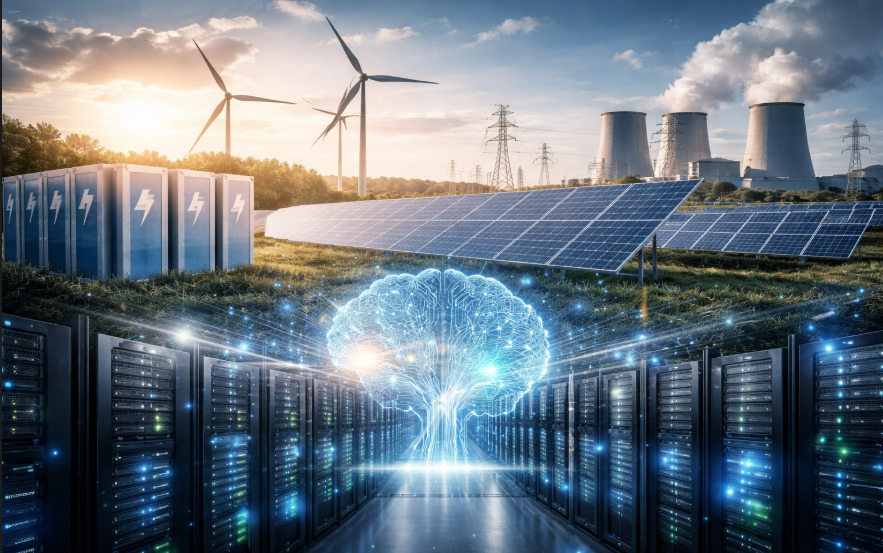
Why AI Energy Investment Is the Smartest Bet Today

The AI Energy Investment story might not be what you expect. Everyone talks about the next breakthrough model or clever AI app, but the real shift sits deeper. Power shortages now slow data centres across the globe, creating a new opportunity. This article explains why energy tech is becoming the backbone of AI growth and what that means for investors.
You already know what happens when demand outruns supply. AI keeps expanding fast, yet electricity infrastructure struggles to keep up. That gap is where smart investors start paying attention. Instead of chasing hype, the focus moves toward solutions that actually keep AI running.
Why AI Energy Investment Is Shifting Toward Energy Tech
First, take a step back and look at the numbers. Venture firms have poured over half a trillion dollars into AI companies in recent years. That sounds massive, yet many data centre projects remain delayed due to limited power access.
These delays tell a bigger story. Around 36% of planned facilities have slipped timelines, while only a small portion of global capacity pipelines actually move forward. AI needs constant, reliable energy, and without it, growth stalls.
Energy tech solves this bottleneck directly. Instead of layering more software, it strengthens the foundation. That is why AI Energy Investment is shifting toward infrastructure rather than applications.
Data Centre Demand Driving AI Energy Investment Growth
The scale of demand is hard to ignore. AI servers alone could increase data centre electricity use by 175% by 2030, according to Goldman Sachs. That is equivalent to adding the energy demand of an entire country.
Today, data centres consume about 1.5% of global electricity. By 2030, International Energy Agency estimates that could reach nearly 945 terawatt-hours.
On the ground, the impact is clear:
-
Grid connection delays stretch into years
-
Electricity prices rise in key regions
-
Companies explore alternative energy sources
This is exactly where AI Energy Investment becomes critical solving the power gap unlocks future AI growth.
Energy Efficient Training Methods for Sustainable AI Models
Big Tech Driving AI Energy Investment Forward
Major tech companies are already moving. Google and Meta are investing directly in energy infrastructure to secure long-term supply.
Google, for example, has signed large clean energy deals combining wind, solar, and battery storage. Meanwhile, Meta continues expanding similar partnerships to stabilise its data centre operations.
One standout example is Form Energy. The company develops long-duration batteries capable of storing energy for up to 100 hours. Google has already backed it with significant funding.
These moves show that AI Energy Investment is no longer theoretical—it is already happening at scale.
Technologies Powering AI Energy Investment Opportunities
Several key technologies are shaping this space.
First, long-duration batteries.
Iron-air and advanced storage systems allow energy to be stored for days, not just hours. This ensures reliability even when renewable sources fluctuate.
Second, smart grid software.
Platforms from companies like GridBeyond optimise energy usage in real time, reducing waste and improving efficiency.
Third, on-site energy generation.
Firms such as Amazon and Oracle are exploring hybrid systems combining solar, storage, and backup power.
Together, these innovations strengthen the case for AI Energy Investment as a long-term growth driver.
Nuclear Power and AI Energy Investment Expansion
Nuclear energy is gaining attention again, especially for AI workloads. It provides stable, continuous power something renewables alone cannot guarantee.
Small modular reactors (SMRs) are particularly promising. They are faster to build, scalable, and can be placed close to data centres, reducing transmission losses.
Tech companies are already backing these projects to ensure reliable energy supply. Nuclear also aligns with sustainability goals, offering low-carbon baseload power.
This makes nuclear a key pillar in the broader AI Energy Investment landscape.
How to Approach AI Energy Investment Today
If you want to act on this trend, start with a few practical steps.
Follow trusted research sources:
-
International Energy Agency
-
Goldman Sachs
These provide insights into demand trends and regional opportunities.
Explore public and private markets:
Look at companies focused on:
-
Energy storage
-
Grid infrastructure
-
Advanced nuclear
You can also explore funds focused on clean energy innovation.
Diversify across sectors:
A balanced mix of storage, generation, and software reduces risk while capturing growth.
For more insights on AI trends, check our internal guide:
Energy Efficiency and Performance of Data Centers
And for energy outlook reports: www.iea.org
The Future of AI Energy Investment
The direction is clear. AI growth will continue pushing energy demand higher for years to come. Without reliable power, even the most advanced systems cannot function.
This is why AI Energy Investment stands out. It focuses on the infrastructure that makes everything else possible. Instead of chasing short-term trends, it targets long-term necessity.
Companies solving energy constraints are positioned to benefit the most. As the gap between power supply and AI demand widens, this opportunity only grows stronger.
Frequently Asked Questions
What makes AI Energy Investment important right now?
Power shortages are delaying AI expansion. Energy solutions directly address this issue, creating strong long-term demand.
How fast is data centre energy demand growing?
It could nearly double by 2030, reaching around 945 terawatt-hours globally.
Are renewables enough for AI needs?
Not alone. They require support from storage systems and nuclear to ensure consistent supply.
Is nuclear part of AI Energy Investment?
Yes. It offers reliable, low-carbon energy that supports continuous AI operations.
Where should beginners start?
Focus on energy storage companies, grid technology firms, and diversified clean energy funds.
Author Profile

- Hey there! I am a Media and Public Relations Strategist at NeticSpace | passionate journalist, blogger, and SEO expert.
Latest entries
 Artificial InteligenceMarch 20, 2026Why AI Energy Investment Is the Smartest Bet Today
 Simulation and ModelingMarch 20, 2026Bezos AI Manufacturing Plan to Transform Global Factories
 AI WorkflowsMarch 19, 2026Rogue AI Agents: Meta Data Leak and AI Safety Risks
 Digital Twin DevelopmentMarch 19, 2026Digital Twins in Fusion Energy Research: Plasma Breakthroughs