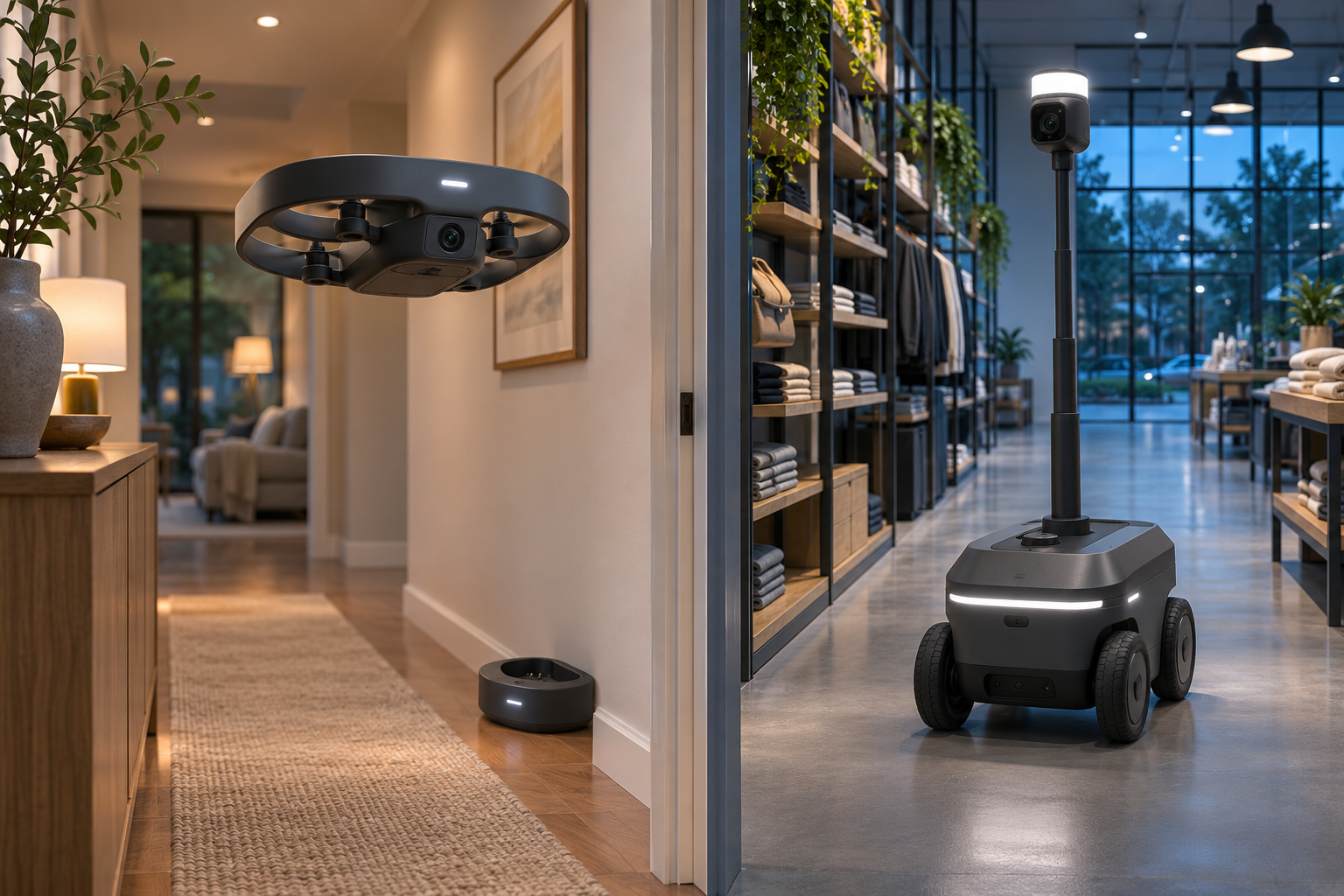
Ring security drone and Rover Cam bring patrols indoors

Ring security drone and Rover Cam bring patrols indoors
The Ring security drone brings a flying camera into the home, while Ring Rover Cam puts a rolling camera on business floors. Ring plans to start U.S. shipments of the $249.99 Drone Cam on January 27, 2027, pending FCC authorization. The $999.99 Rover Cam is scheduled to ship in the U.S. on December 16, 2026. Both products use autonomous navigation to check places that fixed cameras cannot see.
A fixed camera watches one area. By comparison, a mobile camera can move to another room for a closer look. For example, a homeowner could check the hallway after a door sensor goes off. Meanwhile, a shop owner could look behind the counter after closing.
How the Ring security drone maps your home
Drone Cam starts each flight from its charging dock. You can send it out from the Ring app, build a custom patrol route, or set it to fly when a compatible Ring device triggers. Scheduled patrols require a compatible Ring Protect plan. For example, you could set a route that takes the drone past the back door and through the kitchen while you are away.
First, you carry the drone through the rooms you want it to cover. Next, Ring’s AI Pilot system uses that walkthrough to create a floor plan and suggest places for the drone to stop. You can then add your own stops, such as a window at the far end of a room. Once a patrol starts, the system picks a route to each saved point. It then uses its sensors to steer around obstacles. How AI Pilot works
In flight, the camera captures 2K video and can rotate through 360 degrees to look around a room. In low light, two built-in lights switch on. For example, they can light up a dark hallway or a room with the blinds shut. You can watch the flight live in the app and zoom in for a closer look.
How the Ring security drone responds to alerts
A door sensor tells you when a door opens. If you have saved a patrol point nearby, the drone can then fly there and show you the area around the door. In contrast, a scheduled flight lets you check the same rooms in the same order without waiting for an alert. You can also start a flight yourself if you want to check on something before the next scheduled patrol.
A mobile camera also changes where you need a clear view. With a fixed camera, the main question is what you can see from the mounting point. With a flying camera, the route determines which rooms and angles you can see. For instance, a patrol point just inside a room may give you a better view than one in the hallway. Likewise, a closed interior door can cut off a planned view. For readers planning the network behind their cameras, see our wireless network setup guide for smart homes.
How Rover Cam differs from the Ring security drone
Rover Cam puts the same idea on wheels for businesses. Specifically, it can map up to 5,000 square feet on one indoor floor. During setup, the robot explores the space and builds a map. From there, a business owner can select rooms or viewpoints to check, send it on demand, or schedule regular rounds with a compatible subscription. Rover Cam product details
The robot has an adjustable camera mast that can rise above a counter or shelf. For example, owners can save a higher camera position near the checkout. On its next patrol, the robot can then return to that spot for a full sweep of the room. In addition, Rover Cam streams and records video at up to 4K while it patrols. Its light tower, siren, and two-way audio give staff ways to respond from the app. Rover Cam launch details
For a shop, a scheduled round could cover the sales floor and stockroom after closing. If a linked sensor triggers later, the robot can travel to a saved viewpoint and show staff what is happening nearby. However, Rover Cam cannot climb stairs, so one unit cannot patrol stockrooms on different floors. The product listing also flags glossy black floors as incompatible.
Ring security drone privacy controls and launch dates
Drone Cam turns off its camera while it sits in the dock and begins recording when a flight starts. Meanwhile, Rover Cam has a Sleep Mode that retracts the camera mast and switches off the microphone. Both models use LED lights to show when they are recording, and the rover also shows its recording status on its screen. In addition, Ring says it will protect video from both devices with its Throw Away the Key encryption. Privacy controls in the launch announcement
The two designs make recording noticeable in different ways. A flying patrol is audible because of the propellers, while a rolling patrol can use a bright light tower. However, Rover Cam can detect a person and start recording while it is docked. As a result, the dock location affects what the camera can see between patrols.
U.S. buyers can preorder Rover Cam ahead of its planned December shipment. Meanwhile, Ring offers email updates for Drone Cam ahead of the planned January release. Sales still depend on FCC authorization. The two launch dates give households and businesses different timelines to plan around. What they share is a way to send a camera to a room when an alert leaves you wondering what happened there. U.S. launch details