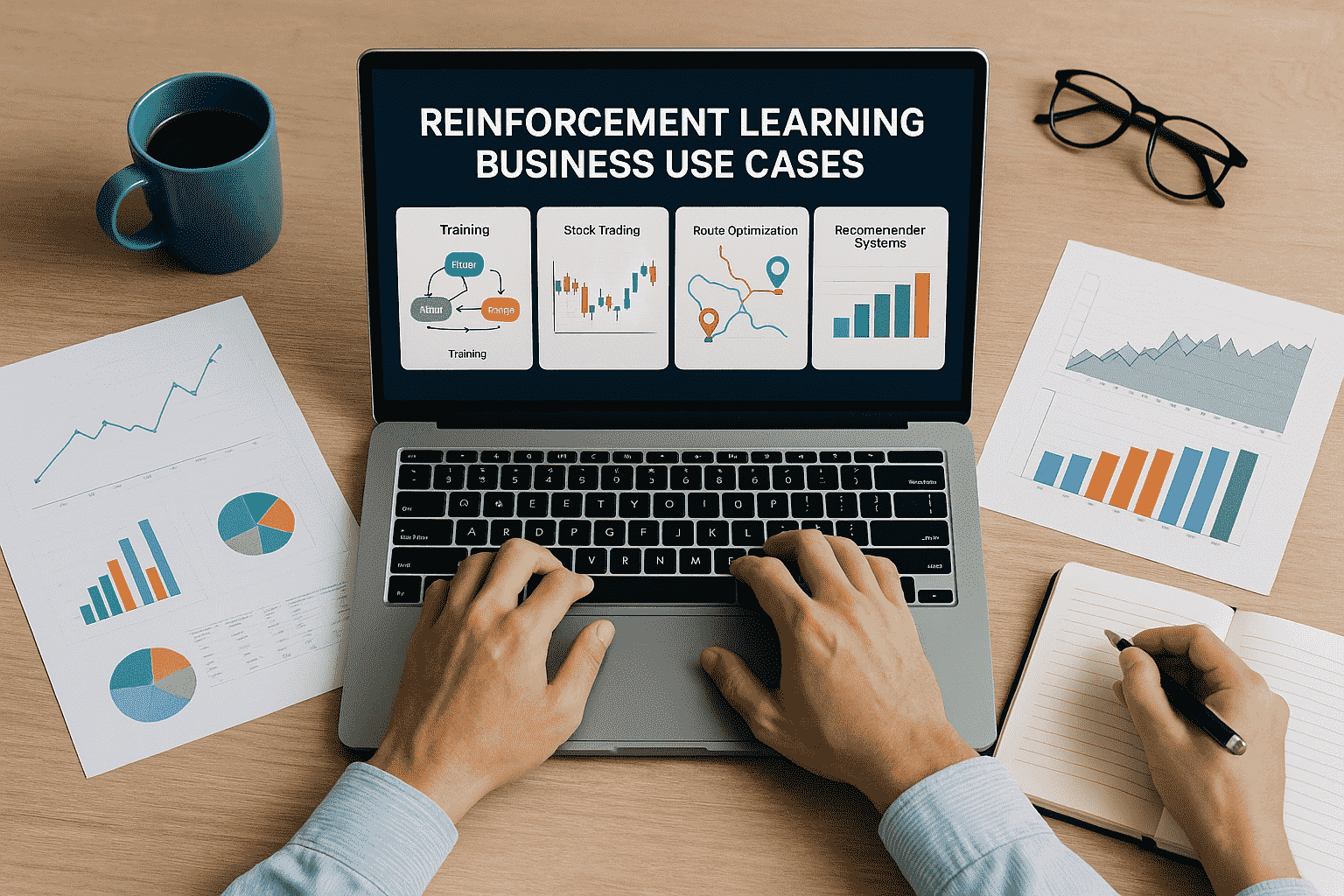
Reinforcement Learning Business Use Cases for Optimization

Reinforcement learning business strategies are changing how organizations solve complex operational problems. Instead of relying on fixed rules, companies now use systems that learn through experience and improve decisions over time. From finance to logistics, this approach helps businesses adapt faster, reduce costs, and unlock new efficiencies. In this guide, I’ll walk you through practical, real world examples so you can clearly see how this technology fits into everyday business operations.
Understanding Reinforcement Learning Business Fundamentals
Before jumping into examples, it helps to understand what makes reinforcement learning business solutions different from other AI approaches. At its core, reinforcement learning involves an agent, an environment, and a reward system. The agent takes actions, observes results, and learns which decisions produce the best long-term outcomes.
Traditional models often struggle when conditions change. In contrast, reinforcement learning adapts continuously using real interaction data rather than static datasets. This makes it especially valuable for industries where uncertainty and rapid change are common.
A simple analogy is teaching through feedback. Just as people learn faster when they see the results of their choices, machines improve by being rewarded for good outcomes and penalized for poor ones. If you want a deeper technical overview, Neptune.ai provides a clear explanation of reinforcement learning concepts.
How Reinforcement Learning Business Systems Work in Practice
A reinforcement learning business model begins by defining an environment such as a warehouse, supply chain, or financial market. The agent then tests different actions, measures outcomes, and gradually refines its strategy.
First, businesses often use simulations to experiment safely without risking real assets. Next, the system runs repeated trials, learning what works and what fails. Finally, those insights are deployed into live operations to optimize results like delivery speed, energy usage, or pricing decisions.
What makes this powerful is the feedback loop. Unlike rule-based automation, reinforcement learning evolves as conditions change. Consulting firms such as McKinsey highlight how simulation-based learning accelerates adoption across enterprises.
Reinforcement Learning Business Use Cases Across Industries
The strength of reinforcement learning business applications lies in their flexibility. Below are real-world use cases across major industries that show how adaptable this approach can be.
Finance and Trading With Reinforcement Learning Business Models
In finance, reinforcement learning business tools help decide when to buy, sell, or hold assets. Agents analyze historical data, simulate market conditions, and continuously adjust strategies to maximize returns.
For example, financial institutions use reinforcement learning to evaluate risk exposure and automate trading decisions. These systems learn from past mistakes, reducing human bias and emotional errors.
Beyond trading, banks apply reinforcement learning to fraud detection and credit scoring. By recognizing unusual patterns early, they reduce losses and improve compliance. IBM’s work in financial optimization is discussed in detail here.
Supply Chain and Logistics Using Reinforcement Learning Business Optimization
Logistics companies rely heavily on reinforcement learning business systems to optimize routing, inventory flow, and delivery schedules. Ride-sharing platforms like Uber and Lyft use it to dynamically route drivers based on traffic, demand, and location data.
The process starts with mapping routes and constraints. Then the system adjusts in real time for traffic, weather, or delays. Over time, this reduces fuel costs and improves customer satisfaction.
Amazon also applies reinforcement learning to warehouse robotics, enabling faster picking and better space utilization. A detailed overview of logistics applications is available on GeeksforGeeks.
Retail and E-Commerce Powered by Reinforcement Learning Business Intelligence
In retail, reinforcement learning business strategies drive personalized recommendations and dynamic pricing. Platforms like Amazon and Netflix continuously learn from user behavior to suggest products or content that increases engagement.
First, the system learns customer preferences. Next, it tests different recommendations. Finally, it optimizes results by reinforcing successful outcomes. This approach boosts conversions and customer retention.
Reinforcement learning also plays a major role in digital advertising through real-time bidding and campaign optimization. V7 Labs shares useful examples in marketing and e-commerce contexts.
Manufacturing Efficiency Through Reinforcement Learning Business Systems
Manufacturers use reinforcement learning business solutions to control robots, improve quality assurance, and optimize production lines. Companies like FANUC allow robots to self-train using simulation and video feedback.
The learning process begins in a controlled environment before being deployed to real machinery. Over time, precision improves, downtime decreases, and productivity rises.
Collaborative robots, or cobots, benefit especially from reinforcement learning as they adapt to human workflows. You can explore manufacturing examples in this Emeritus guide.
Healthcare Resource Planning With Reinforcement Learning Business Logic
Although healthcare focuses on patient outcomes, reinforcement learning business techniques help hospitals manage resources more efficiently. These systems assist with treatment planning, staffing, and medication dosing based on patient responses.
By sequencing decisions over time, hospitals reduce costs while improving care quality. Chronic disease management benefits greatly from adaptive treatment strategies.
Energy Management With Reinforcement Learning Business Solutions
Energy-intensive operations such as data centers use reinforcement learning business models to optimize cooling and power usage. Google’s DeepMind famously reduced data center energy consumption by nearly 40%.
The system monitors conditions, tests efficiency improvements, and applies safe changes automatically. In smart grids, reinforcement learning balances energy supply and demand more effectively.
Neptune.ai also highlights energy optimization use cases here.
Challenges of Adopting Reinforcement Learning Business Systems
Despite its advantages, reinforcement business adoption comes with challenges. Training requires quality data, time, and careful reward design. Poorly defined rewards can lead to unintended outcomes.
To succeed, businesses should start with simulations, involve domain experts, and monitor results closely. Ethical considerations are also important in sensitive areas like finance and healthcare.
If you’re exploring implementation, working with an experienced AI partner helps reduce risks.
Conclusion
Reinforcement learning business applications are proving valuable across finance, logistics, retail, manufacturing, healthcare, and energy. Their ability to adapt, learn from feedback, and optimize long-term outcomes makes them especially powerful in dynamic environments.
If your organization faces complex decision-making challenges, this may be the right time to experiment with a small pilot project and measure the impact.
FAQs
What makes reinforcement learning business models different from other AI?
They learn through continuous feedback, allowing adaptation without fixed rules or static datasets.
Can small businesses use reinforcement learning business solutions?
Yes. Cloud platforms and open-source tools make small scale experimentation affordable.
What are the main risks?
Over-reliance on simulations and poorly designed rewards can cause unexpected behavior.
How does it help marketing teams?
It optimizes personalization, ad bidding, and pricing in real time.
Is reinforcement learning expensive to implement?
Costs vary, but focusing on high-impact areas helps justify investment.
Author Profile

- Hey there! I am a Media and Public Relations Strategist at NeticSpace | passionate journalist, blogger, and SEO expert.
Latest entries
 AI WorkflowsMarch 16, 2026Enterprise AI Factories Enter Production with NTT DATA
 Data AnalyticsMarch 13, 2026Data Lineage Tracking Guide to Understanding Data Lifecycle
 AI PlatformMarch 12, 2026Ask Maps Feature: Smarter AI Navigation in Google Maps
 Robotics SimulationMarch 11, 2026Partnership for Safer Work in Dangerous Environments