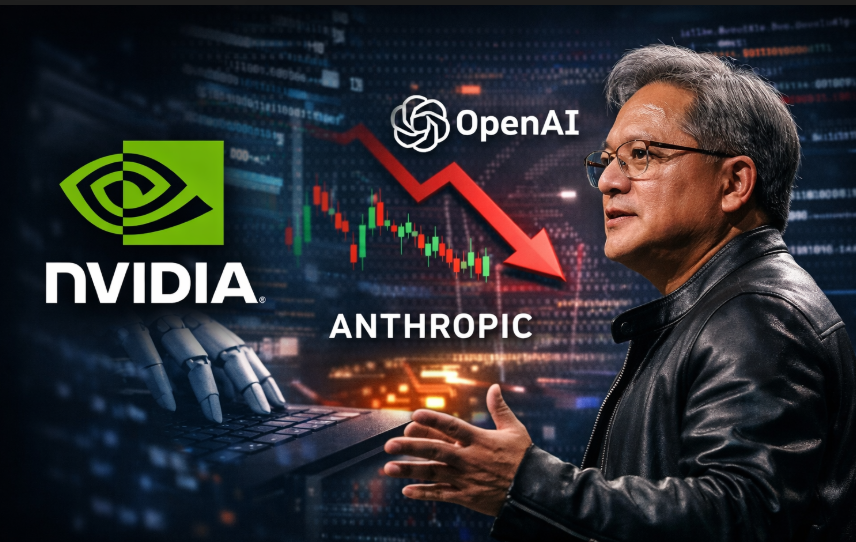
Nvidia Pulling Back From AI Deals: What Huang Really Means

The tech world is buzzing about Nvidia pulling back from major investments in AI startups like OpenAI and Anthropic. The announcement came directly from Nvidia CEO Jensen Huang during a recent industry conference, and it immediately sparked debate across the AI ecosystem.
For years, Nvidia has been one of the most influential forces in artificial intelligence. Its GPUs power training for the world’s largest AI models, from chatbots to advanced research systems. So when Nvidia hinted that its era of massive investments in leading AI labs might be ending, people started asking questions.
Is this simply strategic timing ahead of IPOs, or does it signal deeper shifts in the relationship between chipmakers and AI companies? To understand the story, we need to look at the investments, Huang’s explanation, and how the wider industry is reacting.
Background on Nvidia pulling back from AI investments
Nvidia didn’t become central to the AI boom by accident. Over the last several years, the company aggressively built partnerships with the most influential AI labs. These deals often combined equity investments with long-term chip supply agreements.
In September 2025, Nvidia committed up to $100 billion to support OpenAI’s growth. While that headline number caught attention, the finalized agreement reportedly settled closer to $30 billion, part of a much larger funding round worth about $110 billion.
A few months later, Nvidia partnered with Microsoft in a $10 billion investment in Anthropic. The logic behind these deals was straightforward: the more powerful AI models became, the more advanced GPUs they required.
By investing in the companies building the biggest models, Nvidia ensured a steady pipeline of demand for its chips.
But now, those investments appear to be slowing down. Instead of continuing to pour money into these companies, Nvidia seems to be shifting toward a more traditional role selling hardware rather than taking equity stakes.
Jensen Huang on Nvidia pulling back
During a conference hosted by Morgan Stanley on March 4, 2026, Jensen Huang addressed the situation directly.
According to Huang, Nvidia’s current investments in OpenAI and Anthropic may be the last major capital commitments the company makes to these firms. The main reason, he explained, is that both companies are preparing for potential public offerings.
Once companies move toward IPOs, late-stage private investments typically become less necessary. Shares will soon be available on public markets, meaning investors—including Nvidia—can participate without private funding rounds.
Huang also dismissed speculation that tensions between the companies played a role in the decision. He described Nvidia’s investments as part of a broader strategy to expand its AI ecosystem rather than control partner companies.
Still, some observers feel the explanation doesn’t tell the entire story.
Why Nvidia pulling back raises industry doubts
While Huang’s IPO explanation sounds reasonable on the surface, many analysts think the situation might be more complicated.
One concern involves what some critics call “circular investment structures.” In simple terms, Nvidia invests billions in AI startups, and those same startups spend billions buying Nvidia’s chips. The cycle boosts growth for both sides, but skeptics argue it can artificially inflate valuations.
Economists and analysts have pointed out that this dynamic resembles a financial loop rather than purely independent demand.
Tensions within the AI industry may also play a role. Anthropic CEO Dario Amodei recently criticized U.S. semiconductor exports to China at the World Economic Forum in Davos, comparing chip sales to selling dangerous weapons to geopolitical rivals.
Statements like that highlight growing friction between AI developers and chip suppliers navigating global policy pressures.
At the same time, competition in AI is intensifying. Companies such as Google are rapidly expanding their AI capabilities, while OpenAI and Anthropic increasingly compete for talent, compute resources, and government contracts.
Against this backdrop, stepping back from equity investments could help Nvidia avoid being pulled too deeply into industry conflicts.
Industry reactions to Nvidia pulling back
Reactions across the tech world have been mixed.
Some analysts believe Nvidia is simply locking in gains at the right time. AI valuations are extremely high, and reducing investment exposure before IPOs could be a smart financial move.
Others worry that the decision signals concerns about sustainability in the AI market.
Publications like The Wall Street Journal have highlighted the circular investment pattern between AI labs and hardware suppliers. If these loops weaken, the pace of growth in AI infrastructure spending could slow.
Online tech communities are also debating the move. Some developers argue Nvidia should focus more on increasing GPU supply for researchers and consumers rather than investing in startups.
Investors, meanwhile, are watching closely. If Nvidia reduces financial involvement in major AI labs, it could reshape how funding flows into the AI sector.
For a deeper look at the evolving AI landscape, see our internal guide to AI model development strategies:
Hybrid AI Platforms for Complex Simulations
Implications of Nvidia pulling back for the AI ecosystem
The implications stretch well beyond Nvidia itself.
First, AI companies may become less dependent on hardware partners for funding. Instead, they may rely more heavily on public markets or traditional venture capital.
Second, Nvidia may refocus its strategy on what it does best—designing and selling high-performance chips. With global demand for AI compute still exploding, that alone remains a massive opportunity.
Third, geopolitical and ethical debates around AI could become more prominent. Issues such as export restrictions, national security, and military applications are already shaping the AI industry.
For example, OpenAI recently signed contracts related to defense projects with the United States Department of Defense, while other AI labs emphasize safety-focused development.
As these differences grow, Nvidia may prefer to remain a neutral supplier rather than a deeply invested partner.
If you’re interested in the ethical side of AI growth, explore our article on:
The Ethical Implications of AI in Business
Future outlook after Nvidia pulling back
The next major milestone will likely be the IPO plans for OpenAI and Anthropic.
If those public offerings succeed, Nvidia’s decision may look like perfect timing. The company will still benefit from strong demand for GPUs without tying its capital to volatile startup valuations.
However, if market conditions shift or AI growth slows, Nvidia’s cautious approach could prove even more valuable.
Regardless of what happens next, Nvidia remains central to the AI economy. Every major model from research systems to enterprise tools still relies heavily on its hardware.
That makes the company’s strategic moves especially important for the future of the entire AI industry.
Wrapping up Nvidia pulling back
The story behind Nvidia’s shift is still unfolding, but one thing is clear: the company is adjusting its strategy as the AI market matures.
From massive startup investments to a more focused hardware role, Nvidia appears to be positioning itself for long-term stability rather than short-term hype.
Whether Jensen Huang’s explanation tells the full story remains up for debate. But the decision highlights a broader reality in the AI world partnerships evolve, competition intensifies, and strategies must adapt quickly.
As AI continues reshaping industries, moves like this will likely become more common.
FAQ about Nvidia pulling back
What does Nvidia pulling back mean for AI investments?
It suggests Nvidia may prioritize hardware sales over equity stakes in AI startups, especially as companies like OpenAI and Anthropic prepare for public markets.
Author Profile

- Hey there! I am a Media and Public Relations Strategist at NeticSpace | passionate journalist, blogger, and SEO expert.
Latest entries
 Artificial InteligenceMarch 5, 2026Nvidia Pulling Back From AI Deals: What Huang Really Means
 AI PlatformMarch 3, 2026Hybrid AI Platforms for Complex Simulations
 Artificial InteligenceFebruary 28, 2026Scaling AI for Everyone: A Practical Guide
 AI WorkflowsFebruary 23, 2026Self-Verifying AI Workflows for Reducing Production Errors