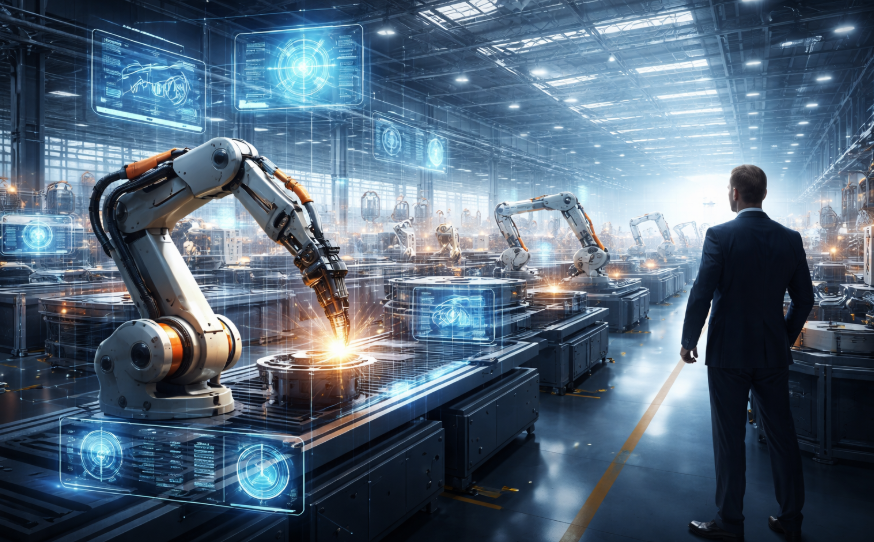
Bezos AI Manufacturing Plan to Transform Global Factories

Bezos AI Manufacturing is quickly becoming one of the most talked-about ideas in the tech and industrial world. The Amazon founder is reportedly working on a massive $100 billion investment strategy to acquire aging factories and modernize them using advanced artificial intelligence. This bold vision could reshape industries that have struggled to keep pace with digital transformation.
According to early reports, the plan focuses on industries like aerospace, semiconductor production, and defence. These sectors rely heavily on precision and efficiency, making them ideal candidates for AI-driven upgrades. If successful, this move could redefine how traditional manufacturing operates in the modern era.
For more on industrial AI trends, check this internal guide:
OpenAI Tata AI Data Centre Deal Transforming India’s Tech
What Bezos AI Manufacturing Means for Legacy Factories
At its core, Bezos AI Manufacturing is about bringing outdated factories into the future. Many manufacturing plants still operate using decades-old machinery and inefficient processes. These limitations lead to downtime, higher costs, and wasted resources.
AI can change that.
With predictive analytics, factories can detect machine failures before they happen. Smart systems can monitor production lines in real time, improving efficiency and reducing waste. For example, AI-powered sensors can identify patterns that humans might miss, allowing managers to act faster and smarter.
In industries like aerospace, even minor delays can result in massive financial losses. AI simulation tools can test entire production workflows before implementation, reducing errors and saving time.
How Bezos AI Manufacturing Connects to Project Prometheus
The vision behind Bezos AI Manufacturing is closely tied to Bezos’s AI startup, Project Prometheus. This company focuses on building “physical AI,” systems designed to understand real-world environments rather than just digital data.
Unlike traditional AI models, these systems can interpret materials, movement, and environmental conditions. This makes them highly valuable for manufacturing applications.
Project Prometheus already has significant backing and talent from leading tech companies. The manufacturing fund would provide real-world environments where these AI systems can be deployed and refined.
Learn more about AI innovation here:
MIT Technology Review – AI in Manufacturing
Why Industries Need Bezos AI Manufacturing Now
Global manufacturing is under pressure. Rising costs, supply chain disruptions, and sustainability demands are forcing companies to rethink their operations. Bezos AI Manufacturing offers a potential solution to these challenges.
First, predictive maintenance can significantly reduce downtime. Studies show that AI can cut machine failures by up to 50 percent. This means fewer interruptions and more consistent production.
Second, quality control improves dramatically. AI-powered vision systems can detect defects with higher accuracy than human inspectors. This is especially critical in industries like semiconductor manufacturing, where precision is everything.
Finally, energy efficiency becomes easier to manage. AI systems can optimize energy use, helping companies meet environmental targets while reducing costs.
Key Benefits of Bezos AI Manufacturing Across Sectors
If implemented successfully, Bezos AI Manufacturing could deliver major advantages across multiple industries.
- Faster production cycles and reduced delays
- Improved product quality and fewer defects
- Safer working environments with automation
- Enhanced supply chain resilience
- Opportunities for workforce upskilling
These benefits are not just theoretical. Many companies already experimenting with AI in manufacturing have reported significant gains in productivity and efficiency.
Challenges Facing Bezos AI Manufacturing Adoption
Despite its promise, Bezos AI Manufacturing comes with challenges. Integrating AI into older systems is complex. Many factories use legacy equipment that does not easily connect with modern software.
Workforce adaptation is another hurdle. Employees need training to work alongside AI systems, and resistance to change can slow adoption.
Security is also a concern, particularly in defence-related industries. Protecting sensitive data is critical, and any breach could have serious consequences.
Finally, raising $100 billion is no small task. Even with strong investor interest, economic conditions could impact funding availability.
The Future Outlook of Bezos AI Manufacturing
Looking ahead, Bezos AI Manufacturing represents a broader shift in how technology interacts with the physical world. For years, innovation has focused on software and digital platforms. Now, attention is turning to real-world systems like factories and infrastructure.
This shift could help revitalize manufacturing in developed economies. Instead of outsourcing production, countries may invest in smarter, more efficient local facilities.
For businesses, the message is clear: adapting to AI is no longer optional. Companies that embrace these technologies early will have a significant competitive advantage.
Conclusion
In summary, Bezos AI Manufacturing combines ambitious investment with cutting-edge AI technology to transform traditional industries. By modernizing factories, improving efficiency, and reducing waste, this initiative could reshape global manufacturing.
However, success is not guaranteed. Challenges around integration, funding, and workforce adaptation remain significant. Still, the potential impact is too large to ignore.
As this story develops, it will be worth watching how quickly these ideas move from concept to reality—and whether they truly deliver on their promise.
FAQs
What is Bezos AI Manufacturing?
It is a proposed $100 billion initiative to acquire and modernize traditional factories باستخدام AI التكنولوجيا.
How does it work?
The plan involves buying manufacturing companies and upgrading them with AI systems to improve efficiency and productivity.
Which industries will benefit most?
Aerospace, semiconductor production, and defence are the primary targets.
Will it replace human workers?
It is more likely to change roles rather than eliminate them, with workers shifting toward higher-skilled tasks.
When will it launch?
The project is still in early stages, so a full rollout may take several years.
Author Profile

- Hey there! I am a Media and Public Relations Strategist at NeticSpace | passionate journalist, blogger, and SEO expert.
Latest entries
 Artificial InteligenceMarch 20, 2026Why AI Energy Investment Is the Smartest Bet Today
 Simulation and ModelingMarch 20, 2026Bezos AI Manufacturing Plan to Transform Global Factories
 AI WorkflowsMarch 19, 2026Rogue AI Agents: Meta Data Leak and AI Safety Risks
 Digital Twin DevelopmentMarch 19, 2026Digital Twins in Fusion Energy Research: Plasma Breakthroughs