Simulating Fusion Energy Reactors with Supercomputers

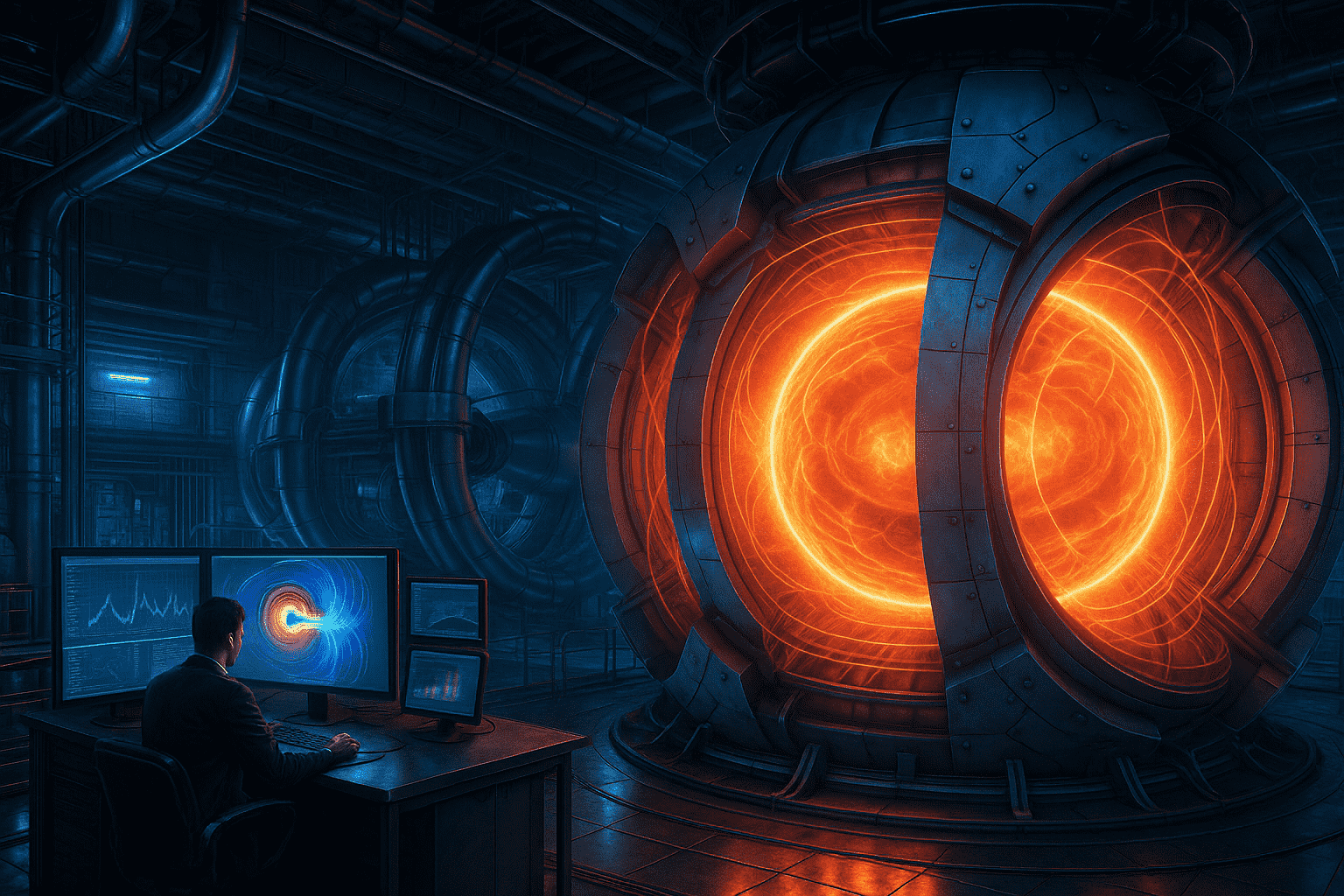
Imagine trying to build a tiny star here on Earth. That’s essentially the vision behind fusion energy reactors, and simulating them has become a secret weapon that lets scientists test concepts long before billions are spent on physical hardware. In this article, we’ll explore how supercomputers are reshaping fusion research, why modeling is essential, and where this technology is heading.
Why Fusion Energy Reactors Are So Hard to Simulate
Fusion occurs when light atoms collide and release massive energy but only at temperatures above 100 million degrees Celsius. No solid material can survive direct contact with that plasma. Engineers can’t simply “test and tweak” a reactor like they would a machine in a workshop. A single design flaw can mean years of delay and billions lost.
That’s exactly why experts rely on supercomputers to simulate fusion energy reactors safely, cheaply, and rapidly. Before building anything, researchers run countless virtual experiments to see how heat, particles, and magnetic turbulence behave.
How Supercomputers Solve the Extreme Physics Inside Fusion Energy Reactors
Inside a tokamak—the donut-shaped machine used in projects like ITER plasma behaves chaotically. Magnetic fields twist unpredictably, turbulence appears at microscopic scales, and changes unfold in milliseconds.
Modern supercomputers solve billions of equations involving trillions of variables. These simulations:
-
Track both particle and fluid behavior (hybrid kinetic-fluid modeling)
-
Predict heat losses and particle escape routes
-
Test potential wall materials without manufacturing them
Systems like the DOE’s Summit and Europe’s coming exascale machines can now model fusion energy reactors at speeds unimaginable a decade ago.
For deeper background on plasma physics, readers can explore the U.S. Department of Energy overview.
ITER’s Breakthroughs Using Simulations of Fusion Energy Reactors
ITER—the world’s most ambitious fusion experiment relies heavily on simulation. This $25-billion collaboration among over 30 countries uses supercomputing to refine nearly every component before construction begins.
Supercomputers such as France’s Joliot-Curie and Japan’s Fugaku ran month-long simulations that uncovered tiny but critical engineering flaws. Fixing those issues saved an estimated two years of construction time. Without advanced modeling of fusion energy reactors, ITER would still be stuck on the drawing board.
For more about ITER’s mission, visit their official site.
Software Tools Powering Today’s Fusion Energy Reactors Simulations
Several specialized codes dominate the fusion modeling landscape:
-
GYRO – captures microturbulence affecting heat loss
-
XGC – models the unpredictable plasma edge
-
NIMROD – studies large-scale disruptions that can damage reactors
-
M3D-C1 – predicts severe plasma instabilities
Researchers often pair multiple codes for maximum accuracy. A typical workflow: prepare inputs → run simulation → analyze petabytes of output → refine reactor design.
For readers wanting a broader technical overview, see the internal guide on computational modeling basics within our platform:
Internal resource: /blog/science/supercomputing-modeling-guide (example placeholder).
Exascale Computing: A New Era for Fusion Energy Reactors
Exascale machines capable of 10¹⁸ calculations per second arrived between 2022 and 2025. Systems like Frontier (Oak Ridge), Aurora (Argonne), and LUMI (Europe) are heavily booked by fusion research teams.
With exascale power, scientists can now run full 3D simulations that include nearly every physics effect simultaneously. Before, they had to simplify the models dramatically. This boosts accuracy and accelerates the day when fusion energy reactors can achieve “burning plasma,” possibly in the 2030s rather than the 2050s.
Private Companies Enter the Fusion Energy Reactors Race
Fusion is no longer just a government project. Private startups—including Commonwealth Fusion Systems, TAE Technologies, and General Fusion have raised more than $6 billion in recent years.
These companies run enormous simulation workloads on cloud supercomputers offered by AWS, Microsoft Azure, and Google Cloud. Cloud power lets small teams compete directly with big national laboratories, modeling fusion energy reactors at massive scale.
Remaining Challenges for Simulating Fusion Energy Reactors
Despite incredible progress, researchers still face major hurdles:
-
Data overload — One simulation can generate 100+ terabytes
-
Complex code coupling — Merging different physics codes remains messy
-
Hard-to-model physics — Neutron damage and quantum effects push computational limits
Machine learning is emerging as a powerful accelerator. AI models can replace slow physics routines, cutting compute times by up to 90% with minimal accuracy loss.
The Future: Real-Time Digital Twins of Fusion Energy Reactors
By 2030, many experts expect functional digital twins of full reactors running in real time. Engineers could adjust magnetic fields on a tablet and instantly see how plasma responds.
That vision depends on improvements in supercomputing, smarter algorithms, and continuous software refinement. Fortunately, all three trends are accelerating rapidly, bringing fusion energy reactors closer to commercial reality.
Conclusion
Simulating fusion energy reactors has transformed fusion energy from distant dream to engineering challenge. Thanks to supercomputers, ITER and dozens of private startups can test ideas virtually before committing to real-world hardware. Clean, nearly limitless energy feels closer than ever and most breakthroughs begin inside a computer long before plasma hits the chamber walls.
What’s your prediction fusion power in the 2030s or 2040s?
FAQs
Q: Why not build small test reactors instead of simulating?
Small tests help, but they can’t reach the temperatures or magnetic strength required for net energy. Simulations remain faster, cheaper, and safer.
Q: How long does a full ITER simulation take?
Even on exascale systems, a high-resolution 3D run takes weeks to months.
Q: Can universities access these supercomputers?
Yes, many national labs offer competitive allocation programs.
Q: Does AI replace physics models?
Not yet. AI speeds up calculations, but the core physics still relies on trusted equations.
Q: Which country leads in fusion simulation?
The U.S. leads in exascale computing, Europe leads major international projects like ITER, and China is building reactors at record speed.
Author Profile

- Hey there! I am a Media and Public Relations Strategist at NeticSpace | passionate journalist, blogger, and SEO expert.
Latest entries
 AI WorkflowsJune 6, 2026Microsoft Scout Agent Transforms Productivity Across M365
 Design and SimulationApril 30, 2026Instagram Content Aggregators Rules for Reach 2026
 AI WorkflowsApril 29, 2026Agentic AI Model: GPT-5.5’s Biggest Leap Yet Explained
 Robotics SimulationApril 17, 2026Robot Brain Technology Transforms Modern Robotics Systems